
Review · SPAIN CAVE TOURS
Guided Tour of Toledo Underground
Toledo has another city beneath it. This two-hour walk links five underground sites that reveal how Muslims, Jews, Christians, and Romans lived in the same remarkable hilltop city. I especially like the exclusive access to places that require an accredited guide, and the way the tour moves beyond grand monuments to focus on water, washing, prayer, punishment, and daily routines. The main consideration is language: the tour is conducted in Spanish, so you will get the most from it if you can follow spoken Spanish.
I also like the compact route and clear structure, with about 20 minutes at each stop. Guide Mónica has earned repeated praise for her warm delivery, clear voice, humor, and ability to make the past feel immediate. The tour is not suitable for wheelchair users or people with mobility impairments, and it requires at least four people to operate.
Five details that make Toledo Subterráneo worth your time
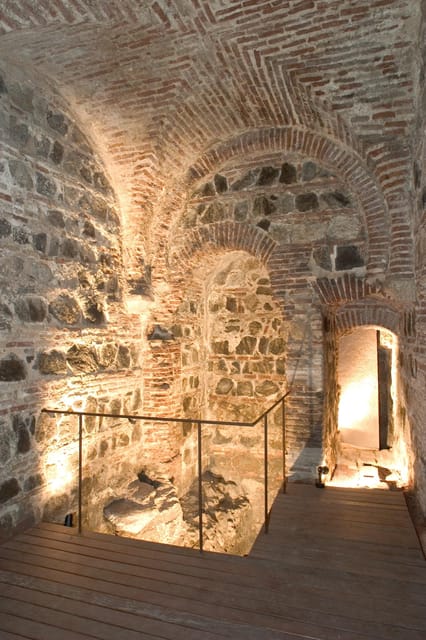
- Five distinct underground sites: You visit an Arab bath, Roman baths, a Jewish mikvah, a well-cistern, and medieval dungeons.
- Mónica’s storytelling: Her engaging explanations and talent for bringing each place to life are a major part of the experience.
- Access beyond ordinary sightseeing: Some sites can only be entered with an official accredited guide.
- A practical look at daily life: Water, hygiene, religious customs, prison routines, and social habits take center stage.
- A gentle price: At $15 per person, the tour offers two hours of guided access for less than many major Toledo attractions.
- A useful walking plan: Begin at Plaza de Zocodover and finish near Plaza Amador de los Ríos, with no transport needed between stops.
Why Toledo’s underground spaces tell a better story
Toledo is famous for its churches, walls, synagogues, and narrow lanes. Yet the spaces below street level often explain the city more clearly than its grand buildings. An underground bath shows how people washed and socialized. A cistern explains how residents managed water on a high stone site. A dungeon gives you a blunt look at law and punishment.
That is the strength of this tour. You are not simply looking at old masonry. You are asked to picture how people used these rooms. The focus stays close to ordinary life, which gives the history a human scale.
The tour also introduces the idea of Toledo as a city shaped by several cultures. Roman Toletum, Muslim Tulaytula, the Jewish quarter, and medieval Christian Toledo all appear along one short route. The sites are different, but together they show how one city changed hands, names, customs, and buildings over many centuries.
I would choose this experience after seeing Toledo’s major sights above ground. Once you have admired the cathedral or walked through the old quarter, the underground tour gives you a fresh way to read the streets under your feet.
More Guided Tours around Spain:
- From Valencia: Caves of San José Guided Excursion and Ticket
★ 4.6 · 1,717 reviews - Nerja: Caves of Nerja Entry Ticket with Audio Guide
★ 4.6 · 1,616 reviews - Palma: Caves of Genova Ticket & Digital Audio Guide
★ 3.9 · 820 reviews
Starting at Plaza de Zocodover
The meeting point is Plaza de Zocodover, the large central square where you will look for a green flag. Arrive 15 minutes early. That small buffer matters in Toledo, where finding the right corner can take longer than expected in the old center.
The opening location is convenient for anyone already sightseeing in the historic center. From there, the route heads on foot through the old city. The finish is at Plaza Amador de los Ríos, so you do not return to the starting point.
The group must have at least four people for the tour to operate. If you are planning around a tight schedule, keep that requirement in mind when choosing your date.
Posada de la Hermandad and the medieval prison
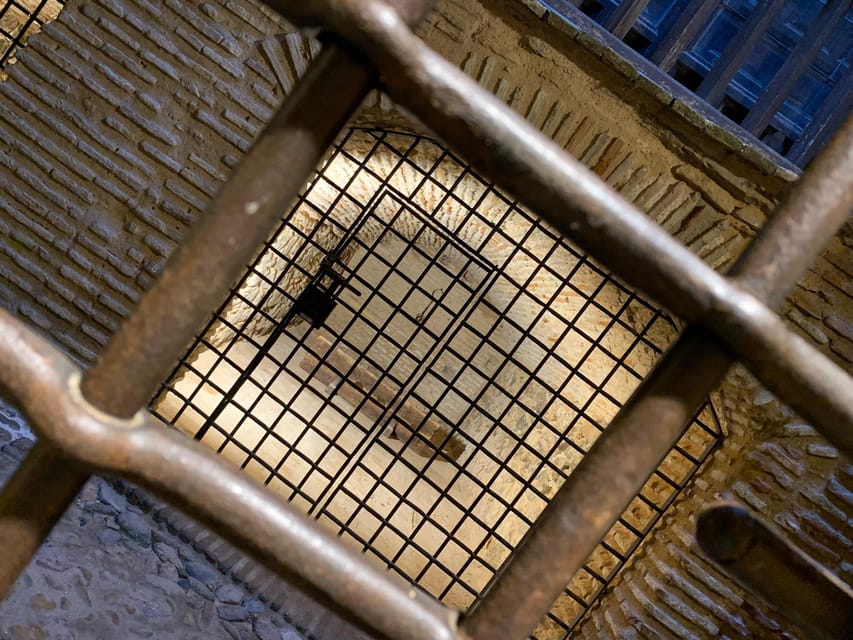
The first stop is Posada de la Hermandad, home to the preserved dungeons of the Holy Brotherhood. These are described as the only surviving dungeons of their kind in Toledo, giving the opening stop a clear sense of place and purpose.
You spend about 20 minutes here. The subject is not royal ceremony but prison life: where prisoners stayed, how the space worked, and who guarded it. The famous jailers known as the Mangas Verdes are part of the story, adding a memorable human detail to what could otherwise be a cold archaeological room.
This is a good first stop because it sets the tone. You will not be asked to admire ruins from a distance. Instead, you will consider what the rooms meant to the people confined and employed there.
The drawback is that dungeons are not comfortable spaces for everyone. If cramped, dark, or uneven places trouble you, this is worth considering before booking. The tour is also specifically unsuitable for people with mobility impairments and wheelchair users.
Baños del Cenizal and Muslim Toledo
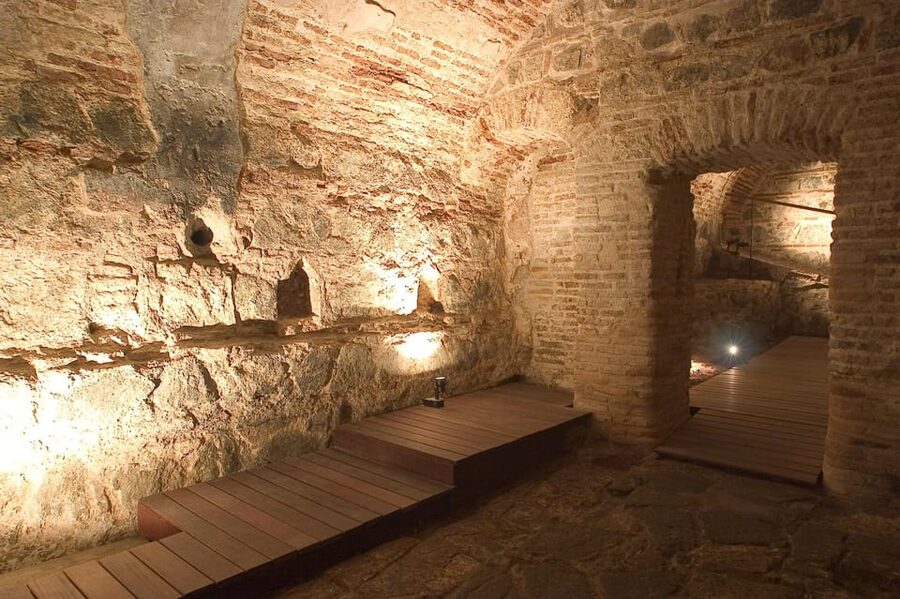
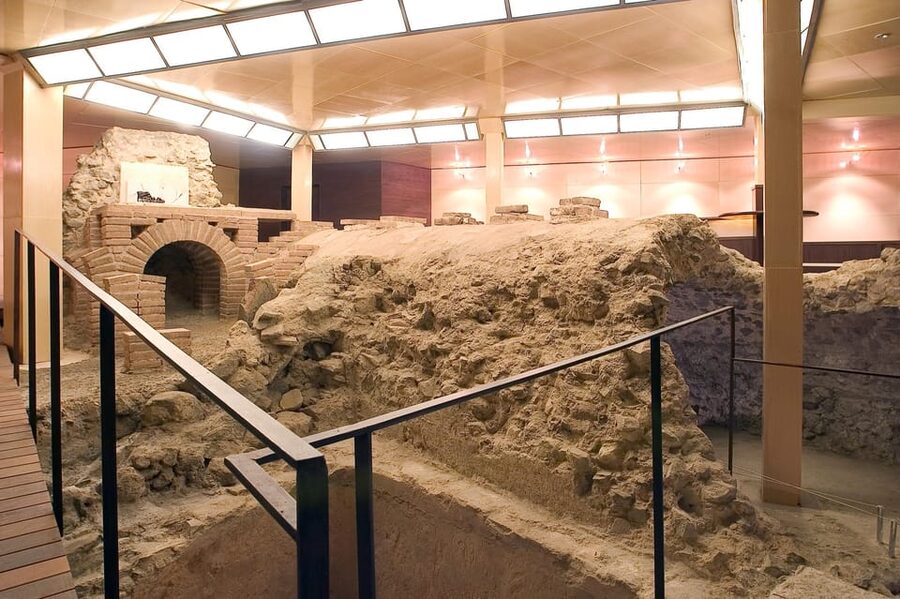
The route then reaches the Baños del Cenizal, an Arab bath connected with 10th-century Tulaytula. This is one of the most useful stops for understanding how hygiene worked in Muslim Toledo.
The guide explains bathing practices, religious washing, and the social role of the hammam. That last point matters. A bath was not only a place to get clean. It was also part of community life, and the rooms can help you picture a routine built around heat, water, preparation, and conversation.
I like this stop because it replaces vague labels about the Muslim period with practical questions. How did people wash? Why did ritual cleanliness matter? What might a visit to the bath mean in the rhythm of daily life? Those questions make the architecture easier to understand.
You get roughly 20 minutes inside. That is enough for a focused explanation, though not enough for a long archaeological lecture. The pace favors clear storytelling over exhaustive detail, which suits the modest two-hour length.
A few more cave trips around Spain worth a look
- Porto Cristo: Caves of Hams Entry Ticket
★ 4.2 · 6,548 reviews - Mallorca: Caves of Drach Day Trip & Optional Caves of Hams
★ 4.3 · 2,720 reviews - From Málaga: Caves of Nerja, Nerja and Frigiliana Day Tour
★ 4.7 · 2,187 reviews - Mallorca: Kayaking, Sea Cave, Cliff Jumping & Snorkel Tour
★ 4.8 · 1,447 reviews
The Pozo del Salvador and Toledo’s water problem
At Plaza del Salvador, the tour examines the Pozo del Salvador. Here, the subject shifts from bathing to drinking water, with a useful distinction between a well and a cistern.
That difference may sound technical, but it is central to life on Toledo’s high rocky site. The stop explains how people obtained drinkable water and how they coped with shortages during droughts. You begin to see the old city not only as a place of palaces and churches, but as a settlement that had to solve basic supply problems every day.
This may be the shortest-looking stop, yet it carries practical value. Water systems reveal how a city survived. The well-cistern also connects naturally with the Arab bath and Roman baths, allowing you to compare different ways of collecting, storing, and using water.
Expect another 20-minute guided visit. Because the subject depends heavily on explanation, the quality of the guide matters here. Mónica has been praised for making her descriptions vivid and easy to follow, which is especially useful at a site where the physical remains may need interpretation.
Casa del Judío and the 14th-century mikvah
The stop at Casa del Judío brings the tour into Toledo’s Jewish Quarter. Here you see a 14th-century mikvah, a Jewish ritual bath linked with the religious life of the community.
The site combines documented history with local legend. That mix can be engaging, but it also means you should listen for the difference between what is known about the space and what belongs to later storytelling. A good guide helps keep both parts in their proper place.
This is one of the tour’s most distinctive stops. Toledo has several celebrated religious buildings above ground, but a mikvah gives you a more private view of Jewish life. Ritual bathing speaks to belief and community practice, while the small underground setting makes the visit feel more personal than a large public monument.
The tour allows about 20 minutes here. If you have a strong interest in Jewish heritage, you may wish the stop were longer. Still, the quick format works well for a first look, especially when combined with the other four sites.
Roman baths beneath ancient Toletum
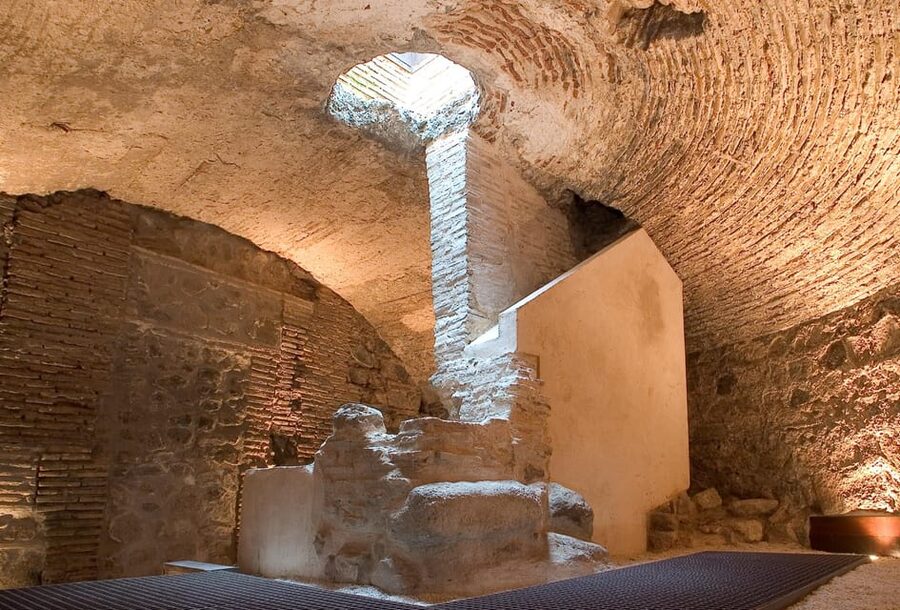
The final site is the Roman baths of Toletum, described as among the largest in Hispania. This gives the tour a strong chronological finish, taking you back before the medieval city and its three major cultural traditions.
Roman baths can be easy to treat as rows of old walls. Their real value comes from understanding the system behind them. The baths were places for washing, social contact, and public life, supported by engineering and water management. After seeing the later Arab hammam, you can compare two bathing traditions and notice both shared needs and different customs.
The Roman stop also broadens the story. Toledo did not begin with the Middle Ages. Roman foundations shaped the city long before the later Muslim, Jewish, and Christian communities left their mark.
You spend approximately 20 minutes here before finishing at Plaza Amador de los Ríos. The ending location places you in the old city rather than back at Zocodover, so plan your next stop from there.
Mónica’s guiding style matters
The guide is not a minor detail on this experience. The underground rooms are often compact, and their meaning is not always obvious from the stonework alone. You need someone who can explain the setting without burying it under dates.
Mónica has received especially warm praise for her clear and pleasant voice, professional manner, humor, and ability to create a strong narrative. One detailed assessment highlighted her talent for making each layer of the city feel connected, rather than presenting five unrelated rooms.
That kind of delivery can make a real difference if Spanish is comfortable for you. The official tour language is Spanish, and some content is presented in its original language. You should not book this expecting an English explanation or translated commentary.
The format is also personal in tone. You move through the city with a guide rather than simply collecting entrance stamps. The best part is likely to be the explanation of how the sites fit into ordinary life.
Is $15 a fair price?
At $15 per person, this is a strong value if you want access to unusual places and a coherent explanation. The price includes the guided tour and entry to five underground sites. You are paying for two hours of interpretation as much as for the rooms themselves.
The value is strongest for first-time visitors who would not know where to find these locations or how to understand them. Some can only be visited with an accredited guide, so this is not simply a walk you can easily copy on your own.
The tour is less useful if you want a long, specialist archaeological visit at every stop. Each location receives about 20 minutes, and the route covers five sites in two hours. Think of it as a lively introduction with real access, not a full research seminar.
Free cancellation up to 24 hours before the start gives you some flexibility, and you can reserve now and pay later. Those terms are useful if your Toledo plans are still shifting.
Who should book this Toledo walk?
I would recommend it to anyone who has at least one night in Toledo and wants more than the major monuments. It suits people interested in architecture, archaeology, religious history, water systems, and the routines of past communities.
It is especially good for Spanish speakers who enjoy guided storytelling. The repeated praise for Mónica suggests that her presentation is one of the experience’s strongest features, but the language requirement remains important.
You should think twice if you use a wheelchair or have significant mobility limitations. The tour is not suitable for wheelchair users or people with mobility impairments, and underground sites may involve conditions that are not comfortable for everyone.
It also may not suit children or adults who need a very slow pace, though no specific age restriction is provided. The two-hour duration is manageable, but the group moves through several historic spaces in one outing.
Practical tips for a smoother visit
Arrive at Plaza de Zocodover 15 minutes early and look for the green flag. Since the tour starts in a busy central square, early arrival removes avoidable stress.
Wear comfortable shoes for walking through Toledo’s old center. The tour description does not specify the condition of every passage, but you are visiting underground archaeological spaces and moving between sites on foot.
Keep your group’s language ability in mind. The guide speaks Spanish, and audio recording is not allowed. If you want to remember the details, take notes after the tour rather than recording the explanations.
Allow extra time after the finish if you want to continue exploring. The route ends at Plaza Amador de los Ríos, not at Plaza de Zocodover, so your next stop may be in a different part of the old city.
Should you book Toledo Subterráneo?
Book this tour if you want to understand Toledo through its practical spaces: baths, water storage, ritual washing, and prisons. For $15, five sites and a strong Spanish-speaking guide offer a lot in two hours.
Skip it if you need English guiding, step-free access, or long visits at individual monuments. For the right audience, though, this is a smart addition to a Toledo stay. It takes you below the famous streets and shows how several cultures handled the same basic needs: water, cleanliness, belief, community, and control.
FAQ
Where does the Toledo Underground tour begin?
The tour begins at Plaza de Zocodover. Look for the guide carrying a green flag and arrive 15 minutes early.
Where does the tour finish?
The tour finishes at Plaza Amador de los Ríos.
How long does the tour last?
The guided experience lasts two hours.
How much does the tour cost?
The price is $15 per person.
Which underground sites are included?
You visit the dungeons of Posada de la Hermandad, the Baños del Cenizal, the Pozo del Salvador, the Casa del Judío, and the Roman baths of Toletum.
Is the tour offered in English?
The live guide language is Spanish. Some content is shown in its original language.
Is the tour suitable for wheelchair users?
No. The tour is not suitable for wheelchair users or people with mobility impairments.
Can I cancel the booking?
Yes. You can cancel up to 24 hours in advance for a full refund.
Does the tour require a minimum number of people?
Yes. A minimum of four people is required for the tour to operate.
Just added around Spain
- Nerja Caves, Tropical Coast Day Trip From Granada with Opt Lunch★ 4.5 · 50 reviews
- Flamenco Show in the Caves of Sacromonte★ 4.5 · 26 reviews
- Kayaking Adventure Route with Snorkeling in Mogan Caves★ 5.0 · 316 reviews
- e-Bike Mountain Tour inside a Natural Park+option Tapas in a Cave★ 5.0 · 26 reviews
- Kayak & Snorkeling Tour in Caves in Mogan★ 4.5 · 153 reviews
- Barranco de las Vacas, caves & village by Sky Rebels local guides★ 5.0 · 103 reviews
- Climbing + Zipline + Via Ferrata + Cave. Adventure route in Gran Canaria★ 5.0 · 149 reviews
- Explore Cap Norfeu and the Secret Cave: An Underwater World★ 4.5 · 118 reviews
Spain Cave Tours, compared.

Caves of Drach Day Trip & Optional Caves of Hams
Read our review →
From Málaga: Caves of Nerja, Nerja and Frigiliana Day Tour
Read our review →
Caves of San José Guided Excursion and Ticket
Read our review →
Nerja: Caves of Nerja Entry Ticket with Audio Guide
Read our review →
Kayaking, Sea Cave, Cliff Jumping & Snorkel Tour
Read our review →
Snorkeling and SUP Paddle, Beach and Cave Tour
Read our review →
Browse the lists this cave appears in