
Review · ITALY CAVE TOURS
Cagliari: Underground Cagliari Walking Tour
The best part of Cagliari is underfoot. This tour reveals a quieter side of Sardinia’s capital, moving from a candle-lit WWII shelter to the crypt of Santa Restituta and Roman ruins beneath Saint Eulalia. I like the way it connects recent wartime history with ancient archaeology, rather than treating Cagliari as only a sunny seaside city.
I also like the short walks between Stampace and Marina. They help you understand how the underground sites fit into the old city above. The main thing to consider is the dual-language format: English and Italian are handled by the same guide, so a larger group may hear each explanation twice.
The tour costs $35 per person and lasts from two to four hours, depending on the option you choose. Guides such as Francesca, Valentina, Federico, and Silvia have earned strong praise for their clear explanations and friendly style. Bring good shoes, arrive 10 minutes early, and expect some outdoor walking between the sites.
Key points to know before booking
- A 120-meter WWII shelter: Walk through a private tunnel beneath the Salesian school, once used as a bomb shelter and visited by candlelight.
- Three separate underground sites: The route includes the Salesian School tunnel, Santa Restituta crypt, and Saint Eulalia archaeological area.
- Ancient and modern history together: You move from wartime Cagliari to a fifth-century place of pagan worship and a Roman paved road.
- Optional Old Town or food and wine add-on: Some versions continue with a guided walk, while another includes wine and Sardinian snacks.
- Bilingual guiding: The tour runs in English and Italian, with private group bookings available.
- Not suitable for everyone: Narrow underground spaces, stairs, and walking make this a poor match for wheelchair users, people with mobility limits, or anyone with claustrophobia.
Why Cagliari’s underground is worth your time
Cagliari is easy to admire from above. You have bright streets, old districts, churches, and views toward the water. But the city’s underground spaces tell a different story. They show how people sheltered, worshipped, built, and reused the same ground over many centuries.
I like this tour because it gives you three distinct moods. The WWII tunnel feels close and personal. Santa Restituta is damp, shadowy, and tied to early religious and pagan practice. Saint Eulalia is more archaeological, with Roman remains laid out beneath a church.
That variety matters. A tour made up of only crypts could feel repetitive. Here, each stop changes the subject and the atmosphere. You also walk between the sites, which gives you a chance to reset before heading below ground again.
The experience is not four straight hours underground. You visit three different places and walk outdoors through Stampace and Marina. That makes the tour easier for most people than the name might suggest, though anyone who dislikes enclosed spaces should still think carefully before booking.
A few more cave trips around Italy worth a look
- Naples: Naples Underground Entry Ticket and Guided Tour
★ 4.4 · 21,781 reviews - Colosseum: Underground and Ancient Rome Tour
★ 4.7 · 12,691 reviews - Naples: Catacombs of San Gennaro Entry Ticket & Guided Tour
★ 4.6 · 7,941 reviews
The Salesian School tunnel and its wartime past
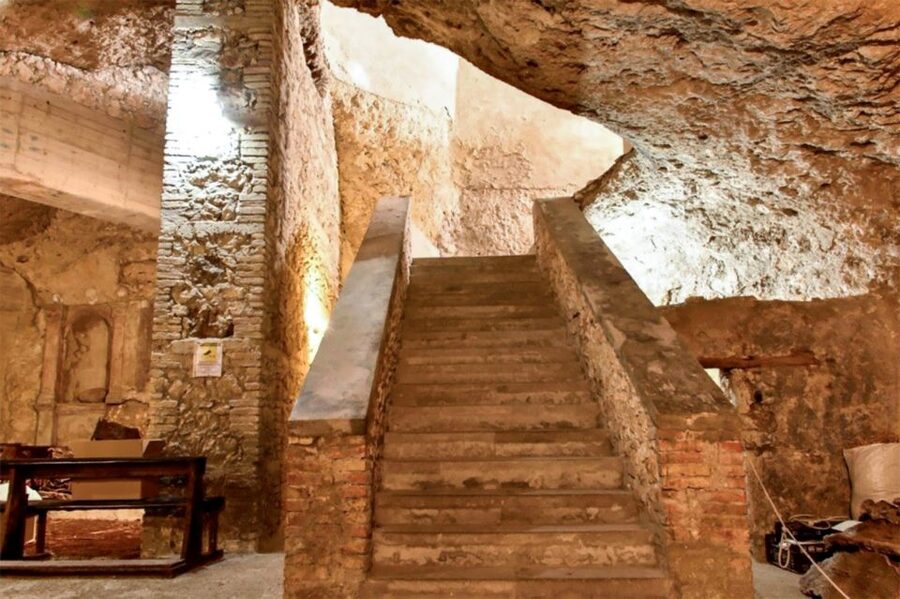
The first major stop is the tunnel shelter beneath the Salesian School, reached at the Istituto Salesiano Don Bosco on Via Sant’Ignazio da Laconi. The tunnel stretches for 120 meters and was used as a bomb shelter during World War II.
This is the most personal part of the tour. Ancient ruins can feel distant, but a wartime shelter connects directly with ordinary people who needed protection during air raids. The private passage also gives the visit a distinctive mood, especially when it is lit by candles.
I would not expect a polished museum display here. The appeal comes from the tunnel itself, its length, its purpose, and the guide’s explanation. The candle-lit setting adds atmosphere without turning the stop into a theatrical show.
Plan on about 40 minutes at this site. Wear shoes with a firm sole, since comfortable footwear is specifically recommended. If you dislike narrow passages, you may find this stop uncomfortable even though the tour is not entirely underground.
The opening visit also gives you a useful frame for Cagliari’s more distant past. You begin with a place shaped by modern conflict, then move backward through the city’s earlier layers.
A short walk through Stampace
After the first site, the group walks for about 10 minutes through Stampace. This outdoor stretch is short, but it helps break up the underground visits.
Stampace is one of Cagliari’s old districts, and the walk lets you see the streets above the tunnel before entering another historic space. Your guide may also point out how the old neighborhoods connect, though the main focus remains the underground route.
This is one reason I prefer the walking format to a series of isolated entries. You are not simply transported from one location to another. You cross the city on foot and gradually link the sites in your mind.
The route does require walking outdoors, so bring an umbrella if rain is expected. The tour takes place in a city setting, not inside one single attraction with every stop connected.
Santa Restituta crypt: water, frescoes, and older worship
The crypt of Santa Restituta brings a very different mood. You spend about 40 minutes below ground, studying surviving frescoes and listening to the sound of water dripping through the damp space.
The crypt is associated with a fifth-century place of pagan worship. That detail gives the site extra depth. You are not looking at a single, untouched period. The space reflects how religious places can carry traces of earlier beliefs and later use.
I find the sound and condition of the crypt important to the experience. The damp air and dripping water are not distractions. They help you picture the underground setting as a living, changing space rather than a dry display room.
The guide’s role matters here. The room itself may not explain every layer clearly, so a strong storyteller can make the frescoes and religious history easier to follow. Guides Federico and Valentina have been praised for keeping explanations interesting, adding humor, and presenting Cagliari’s past in an accessible way.
This is also a place where you should slow down. The tour is not designed as a quick photo stop. You have time to look at the remaining frescoes and take in the atmosphere.
Same corner of the map, a different way in:
- Matera: Sassi Tour with Cave House and Rupestrian Church
★ 4.7 · 6,618 reviews - Rome: Capuchin Crypts and Catacombs Tour with Transfers
★ 4.6 · 6,456 reviews - Naples: Spanish Quarters Underground Guided Tour
★ 4.8 · 5,064 reviews - Expert Guided Tour of Colosseum Arena OR Underground, and Forum
★ 4.5 · 5,041 reviews
Marina and the route toward Saint Eulalia
The next outdoor section takes you through Marina, another old district, with about 10 minutes of walking before the final underground visit.
The walk through Marina gives you a change of pace after Santa Restituta. It also makes the tour feel like a city walk with underground stops, rather than a cave excursion. If you have selected the Old Town extension, this part can lead naturally into a longer look at Cagliari’s historic center.
As with Stampace, the outdoor portions are short but useful. You should not book this expecting a completely enclosed experience. The tour includes streets, transitions, and several starting or ending points depending on the option you select.
Pay close attention to the meeting instructions on your booking. The meeting point can vary, and one visitor had trouble finding parking in central Cagliari. Arriving 10 minutes early is sensible, especially if you are driving.
Roman remains beneath Saint Eulalia
The final main stop is the MUTSEU Museum of the Treasury and Archaeological Area of Saint Eulalia. Here, you see Roman remains beneath the church, including a paved Roman road.
This is likely the strongest stop for anyone who enjoys archaeology. A road is a wonderfully practical ruin. It shows how the city worked, not just how it worshipped. You can picture movement, construction, and daily life through something as basic as paving.
The Saint Eulalia area also gives the tour a clear ending. You have seen a modern shelter, an early religious crypt, and Roman remains. Together, the three locations show Cagliari as a city built in layers.
Allow about 40 minutes for the guided visit. The stop is included in the entry fees, and the archaeological area may be especially useful if you already planned to visit the museum. One visitor was pleased to discover that the archaeology museum formed part of the tour.
The final location is also practical. Depending on the option, the tour can finish near Saint Eulalia, Piazza Yenne, or other listed points in the old center. That makes it easy to continue sightseeing, find a meal, or join the optional extension.
The Old Town extension and food option
Some versions add a guided walk through Cagliari’s Old Town after the three underground visits. This is a good choice if you are new to the city and want help connecting the sites with the streets above.
The extra walk lets you see historic-center highlights with your guide. It also extends the experience toward the four-hour end of the stated duration. I would choose it if you want one organized introduction to the city rather than a stand-alone archaeology visit.
Another option includes a wine tasting and snack. The food element should be understood correctly: it may be a glass of wine with Sardinian snacks rather than a long tasting session with several wines. That can still be a pleasant finish, but the description may create bigger expectations than the actual serving.
One visitor who added this option enjoyed the time with guide Silvia, especially because the small group made the experience personal. The size of your group may differ, so think of the food add-on as a light local stop, not a full meal.
Guides, group size, and language
The tour is guided in English and Italian. This makes it useful for mixed-language groups, but the format has a tradeoff. In a large group, the guide needs to repeat explanations in both languages, which can lengthen each stop and make the presentation feel less direct.
A group of about 25 people may feel crowded in smaller underground areas. One person specifically found it would have been easier with separate English and Italian guides. If you want more time for questions or a quieter pace, look for the private group option.
The guiding itself receives strong praise. Angela appreciated a guide who switched between languages clearly and did not rush the group. Carlo highlighted the guide’s English. Other named guides, including Francesca, Valentina, Federico, and Silvia, have been praised for clear delivery, enthusiasm, humor, and strong command of the subject.
Those details are useful because underground sites depend heavily on interpretation. The spaces are interesting on their own, but the guide explains why a tunnel mattered, what the crypt was used for, and how the Roman remains fit into Cagliari’s past.
Is $35 a fair price?
At $35 per person, the price is reasonable if you want all three underground entries with a guide. Entry fees are included, and the tour covers sites that would be harder to understand if you visited them separately.
The value is strongest for first-time visitors. You receive an organized route, local context, and help moving between Stampace, Marina, and the old center. You also avoid the work of planning three separate visits.
The price is less compelling if you only want a quick look at one site or prefer to explore at your own speed. A larger bilingual group can also make the experience feel slower than a private visit.
Private groups are available, though the supplied details do not state the private-group surcharge. If you choose that format, you may gain a more flexible pace and easier communication, especially if everyone in your party speaks English.
The wine and snack option may add value for people who want a small social finish. Just keep your expectations modest. It is described as a wine tasting with snacks, but the experience may amount to one glass and a selection of Sardinian bites.
Who should book this tour?
I would recommend it to you if you enjoy history, archaeology, churches, and old city walks. It is also a smart choice if you have already seen Cagliari’s sunny streets and want something less obvious.
Families with older children may enjoy the WWII shelter and Roman road, though parents should consider the enclosed spaces and walking time. Couples and solo visitors can also use the tour as a compact introduction to the city’s past.
I would be cautious if you have limited mobility, use a wheelchair, have a visual impairment, or feel anxious in tunnels. The tour is specifically not suitable for those needs. It also requires some outdoor walking and comfortable shoes.
Book the Old Town extension if you want a fuller city introduction. Choose the wine and snack option if you want a light local finish, not a full meal or lengthy tasting.
Should you book the Cagliari Underground Walking Tour?
You should book this tour if you want three contrasting sites in one route and value a guide who can explain what you are seeing. The WWII shelter, Santa Restituta crypt, and Saint Eulalia ruins each offer something different, and the $35 price includes entry to all three.
Skip it if narrow spaces make you uneasy or if you prefer independent sightseeing. Also consider a private group if you dislike bilingual presentations or want more room for questions.
For most able walkers with an interest in Cagliari’s past, this is a useful, well-priced way to see the city from below, then return to its streets with a better sense of what lies beneath them.
FAQ
How much does the Cagliari Underground Walking Tour cost?
The tour costs $35 per person.
How long does the tour last?
The experience lasts between two and four hours, depending on the option selected.
Which underground sites are included?
The tour visits the Tunnel-Shelter of the Salesian School, the crypt of Santa Restituta, and the Archaeological Area of Saint Eulalia.
Is the tour entirely underground?
No. The tour includes outdoor walking between the sites, including sections through the districts of Stampace and Marina.
What languages are available?
The live guide speaks English and Italian. The tour operates in both languages.
Is a private tour available?
Yes. A private group option is available.
Does the tour include a wine tasting?
A wine tasting and snack are included if you select that option. The food element may consist of a glass of wine with Sardinian snacks.
What should I bring?
Bring comfortable shoes. An umbrella is suggested if rain is expected.
Is the tour suitable for wheelchair users or people with claustrophobia?
No. The experience is not suitable for wheelchair users, people with mobility impairments, people with claustrophobia, or people with visual impairments.
Just added around Italy
- From Capri: Blue Grotto, Capri and Anacapri Guided Tour★ 4.8 · 91 reviews
- From Catania: trek on Mount Etna, Lava Cave & tasting Tour★ 4.8 · 563 reviews
- Explore Christian Rome and the Underground of San Clemente★ 4.4 · 16 reviews
- Etna Jeep Tour: Explore Craters and Lava Caves, Etna Wine Brunch★ 4.9 · 17 reviews
- EXCURSION VISIT TO THE SANTA MARIA DI LEUCA CAVES★ 4.8 · 192 reviews
- Santa Maria di Leuca: Caves Boat Tour★ 4.6 · 211 reviews
- East Palermo: boat tour among caves and breathtaking landscapes★ 5.0 · 28 reviews
- Taormina and Giardini Naxos: 2 Hour Dolphin Tour & Grotto★ 4.6 · 63 reviews
Italy Cave Tours, compared.
Naples Underground Entry Ticket and Guided Tour
Read our review →
Colosseum: Underground and Ancient Rome Tour
Read our review →
Catacombs of San Gennaro Entry Ticket & Guided Tour
Read our review →
Sassi Tour with Cave House and Rupestrian Church
Read our review →
Capuchin Crypts and Catacombs Tour with Transfers
Read our review →
Expert Guided Tour of Colosseum Arena OR Underground, and Forum
Read our review →
Browse the lists this cave appears in