
Review · LECCE CAVE TOURS
Lecce guided tour with underground discoveries
Lecce rewards a slow look. This two-hour walking tour links the city’s grand Baroque churches and palaces with the unusual underground remains beneath the Faggiano Archaeological Museum. I like the mix of street-level architecture and archaeology, and I like that the guide adds meaning to details you could easily walk past. The main point to consider is the underground portion: some guests found the museum visit brief and largely self-guided after the walking section.
Guides such as Fabio Grasso, Fabio, Elena, Ilenia, Antonella, Francesca, and Fabrizio have earned strong praise for clear English, patience, and a real affection for Lecce. The tour costs $41 per person, which feels fair if you have only a short time in town and want a guide to connect the sights rather than simply point at them.
Key points to know before booking
- The tour covers Lecce’s central Baroque sights: Piazza Duomo, Corso Vittorio Emanuele, Piazza Sant’Oronzo, churches, and palaces.
- Santa Croce gets useful architectural context: Guides explain the meaning behind details on its highly decorated facade.
- The Faggiano Archaeological Museum ticket is included: You do not pay extra for the museum portion.
- Expect a compact two-hour walk: The route suits a first look at Lecce, especially when time is limited.
- English and Italian tours are available: Fabio Grasso and several other guides have been praised for clear, engaging explanations.
- Paid church entries are not included: The tour focuses on exterior interpretation and the included museum ticket.
Why Lecce’s Baroque deserves a guided walk
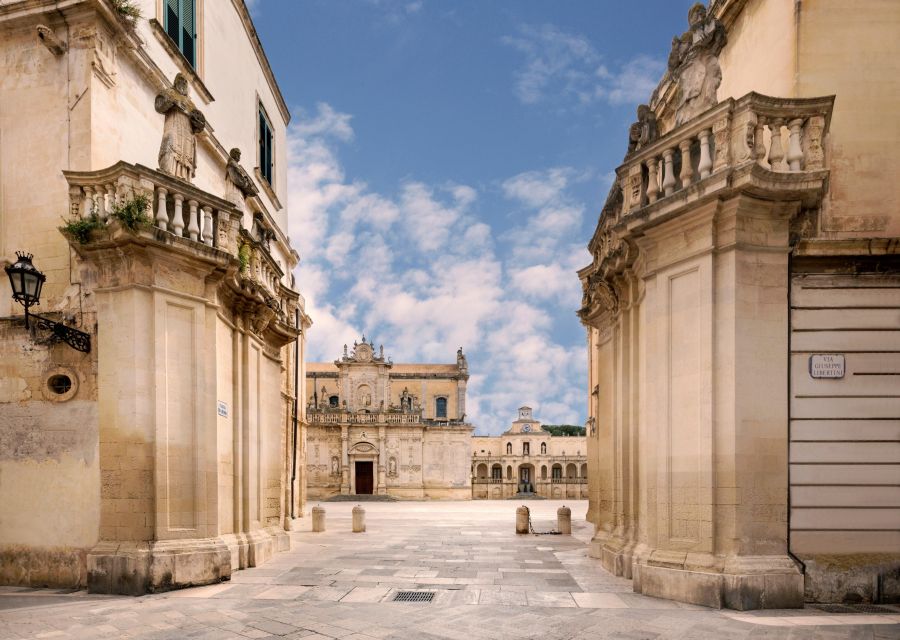
Lecce is not a city you fully understand by taking a quick photograph of a church facade. Its Baroque style is packed with carved figures, scrolls, columns, fruit, animals, and other details. Without some explanation, it can all blur into one grand display of pale stone.
A good guide gives those decorations a job. You learn how the buildings reflect religious devotion, civic pride, and the wealth of local noble families. The city’s historic center becomes less like a collection of pretty streets and more like a conversation between churches, palaces, public squares, and older layers below the pavement.
I especially like the way this tour moves between broad public spaces and narrow cobbled lanes. You get the scale of Lecce in Piazza Duomo and Piazza Sant’Oronzo, then see how the Baroque style continues along Corso Vittorio Emanuele and the side streets.
The format is also practical. In two hours, you can get your bearings, learn which buildings deserve a second look, and leave with enough context to explore on your own. It is not a full study of Lecce, but it is a useful introduction.
More Guided Tours around Italy:
- Naples: Naples Underground Entry Ticket and Guided Tour
★ 4.4 · 21,781 reviews - Naples: Catacombs of San Gennaro Entry Ticket & Guided Tour
★ 4.6 · 7,941 reviews - Naples: Spanish Quarters Underground Guided Tour
★ 4.8 · 5,064 reviews
Piazza Duomo and the first look at Lecce Cathedral
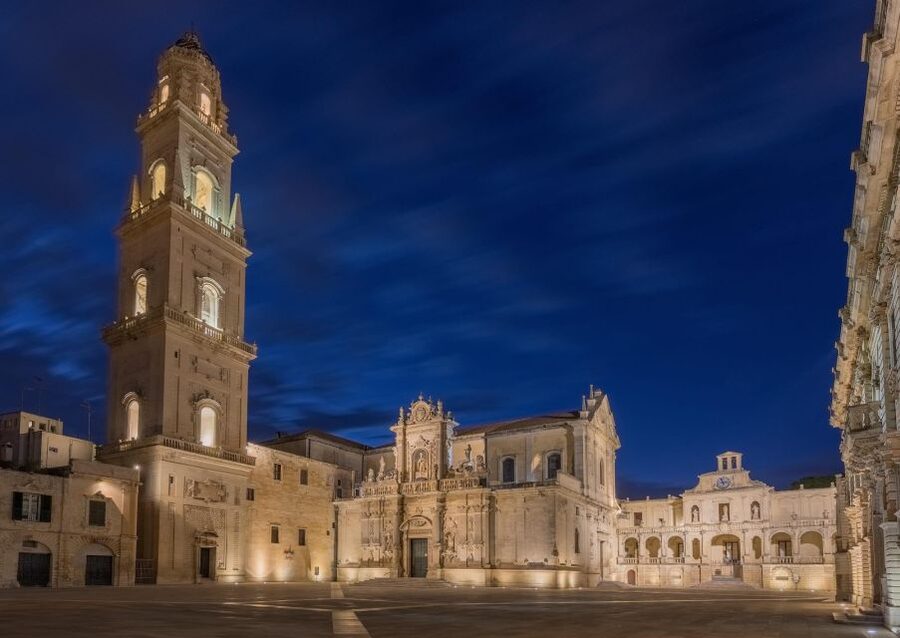
Piazza Duomo is one of the tour’s strongest early stops. The square gives you room to appreciate the cathedral complex as a whole, including Lecce Cathedral and its bell tower. That wider view matters because the Baroque effect is not limited to one facade. The buildings work together around the enclosed square.
The cathedral’s bell tower is an especially important part of the view. Your guide can point out how the tower shapes the city’s profile and how the religious complex was designed to impress visitors arriving in the square.
This is a place where the guide’s architectural background can make a real difference. Fabio Grasso, in particular, has been praised for explaining both individual monuments and the way the historic center was planned. If architecture interests you, listen for those connections rather than focusing only on the names of the buildings.
Piazza Duomo can also feel like a lot to take in at once. The stone is pale, the carving is plentiful, and the scale is grand. A guide who pauses to explain the details helps prevent the square from becoming visual overload.
Corso Vittorio Emanuele and the city’s public face
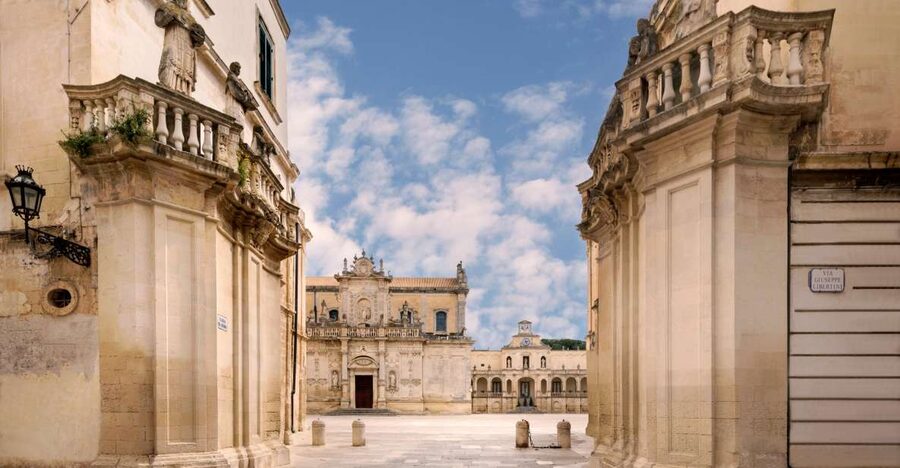
The walk continues along Corso Vittorio Emanuele, one of the central routes through Lecce. This section helps connect the monumental squares with the everyday city. You are not simply moving from one church to the next. You are following a historic street where palaces, religious buildings, and ordinary urban life meet.
The tour’s route through cobbled streets is part of its appeal. Lecce is compact enough that many central sights are close together, but the short distances can hide a lot of detail. A guide can call attention to decorated doorways, stonework, and the relationship between public facades and private residences.
This is also a good stretch for questions. Several guides, including Fabio, Elena, and Antonella, have been praised for making room for questions and checking that everyone can follow the explanation. That matters in a group setting, especially when architectural terms or historical periods come quickly.
The tour is conducted in English or Italian. English-language visitors have repeatedly praised the clarity of the explanations, though the quality of any walking tour still depends on the individual guide assigned that day.
Santa Croce: look closer than the first photograph
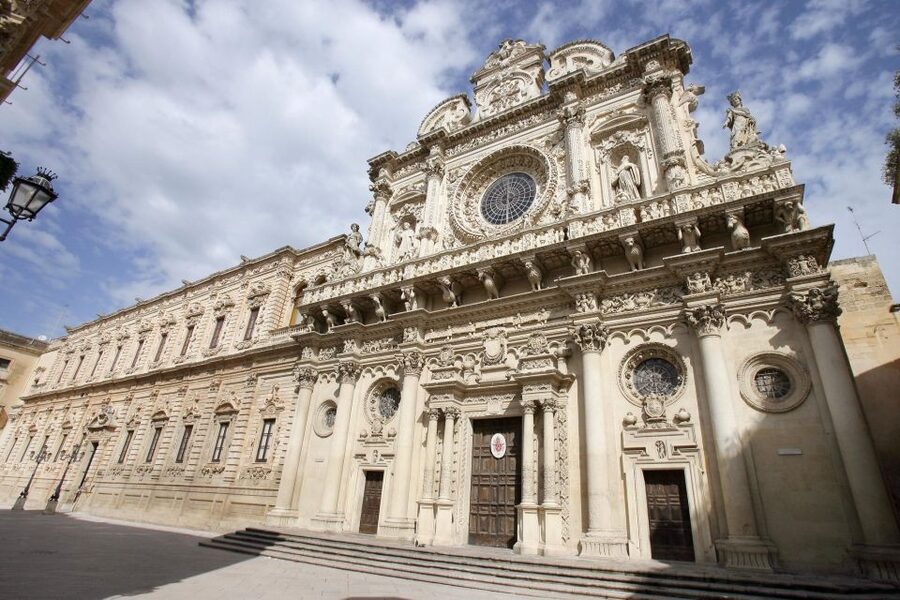
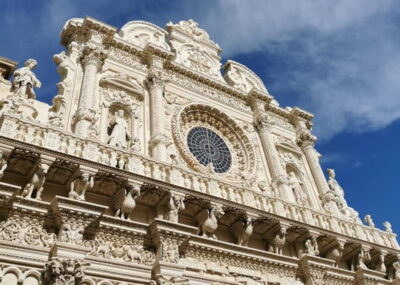
The Basilica of Santa Croce is one of Lecce’s major visual highlights. Its facade is famous for its crowded Baroque decoration, but the best part of a guided visit is learning how to read what you see.
The guide explains the meaning behind features on the facade, rather than leaving you with a general statement that it is ornate. That added context can change the experience. You begin to notice how the sculptures, symbols, and stonework are arranged and why the building feels so theatrical.
One visitor specifically praised the explanation of details on Santa Croce’s facade. That is the kind of information I value most on a city walk. It is not just a fact to remember for a quiz. It gives you a way to look at similar buildings later in your trip.
The basilica itself may require a separate paid entry if you want to go inside. That cost is not part of the $41 tour price. The tour includes the guide and the ticket for the Faggiano Archaeological Museum, but paid church entries are excluded. Ask your guide about the current church-entry arrangements if seeing interiors is important to you.
A few more cave trips around Italy worth a look
- Colosseum: Underground and Ancient Rome Tour
★ 4.7 · 12,691 reviews - Matera: Sassi Tour with Cave House and Rupestrian Church
★ 4.7 · 6,618 reviews - Rome: Capuchin Crypts and Catacombs Tour with Transfers
★ 4.6 · 6,456 reviews - Expert Guided Tour of Colosseum Arena OR Underground, and Forum
★ 4.5 · 5,041 reviews
Piazza Sant’Oronzo and Lecce’s layered story
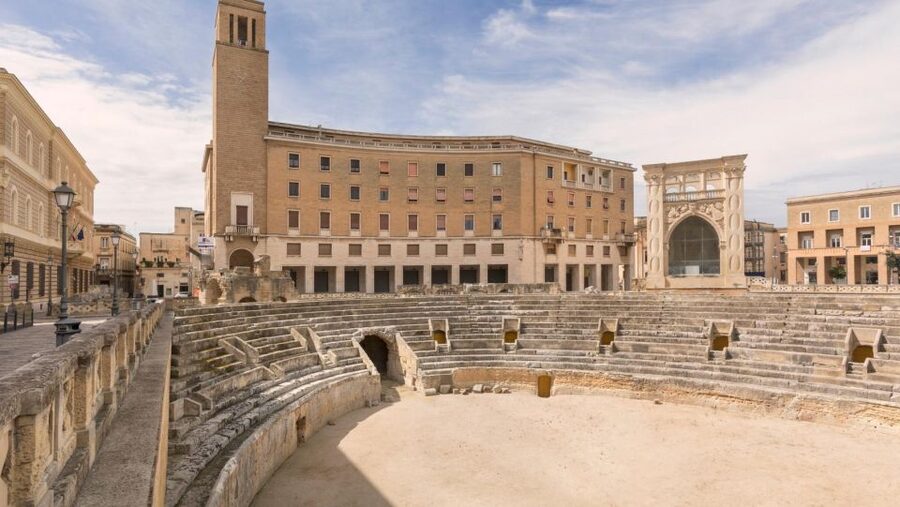
Piazza Sant’Oronzo gives the tour another change of scale. It is a major public square and an important point for understanding how Lecce’s ancient, medieval, and Baroque periods sit beside one another.
Your guide uses the square to explain the city’s development and the connection between its monuments. One guide, Fabrizio, was praised for showing how Lecce grew and how the historic center was designed. That broader view is useful because Lecce’s attractions are not isolated objects. They form a city plan shaped over many centuries.
The square also gives you a sense of Lecce as a living city rather than an open-air museum. The tour passes through active streets and public spaces, so you see the monuments in their everyday setting. It is a more useful introduction than visiting each site separately with no sense of how they connect.
The tradeoff is that two hours goes quickly. You will get an explanation of the main sights, but you will not have unlimited time to linger at every facade or enter every church. If you want detailed interior visits, plan extra time after the tour.
The Faggiano Archaeological Museum and its underground rooms
The Faggiano Archaeological Museum is the tour’s unusual feature. Beneath a private building, archaeological remains reveal earlier stages of life in Lecce. The museum presents artifacts, old structures, corridors, and other traces found below the modern city.
This changes the way you see the streets above. After looking at grand facades and religious monuments, you get a glimpse of the less polished layers beneath them. The underground portion is valuable because it brings daily life and buried traditions into the story, rather than focusing only on churches and noble buildings.
The museum ticket is included, which helps the tour’s value. You do not need to arrange a separate museum visit for this part of the experience.
You should keep your expectations precise, though. The title suggests a substantial underground expedition, but one account found the underground visit more limited than expected. The guide may finish the walking tour at the museum and leave you to explore the exhibits with only a short introduction. The museum offers insight into underground discoveries, but this is not necessarily a long guided archaeological session.
That distinction matters. If you mainly want a guided walking tour of Lecce with an added museum visit, the format works well. If the underground rooms are your main reason for booking, check the exact arrangement on your date and ask whether the guide stays with the group inside.
What the guides add to the experience
The strongest part of this tour is the guide. Fabio Grasso has been praised for his understanding of architecture, monuments, art, and the design of Lecce’s historic center. Fabio has also been described as friendly, enthusiastic, and easy to understand in English.
Elena has received praise for her energy and clear explanations, while Ilenia has been singled out for patience and informative commentary. Antonella was appreciated for speaking clearly and projecting her voice, a small detail that becomes important when a group is standing outdoors near traffic or other visitors.
Francesca was praised for being responsive and for making the explanations interesting. Fabrizio’s architectural and urban-history focus appealed to people who wanted more than dates and names.
The guide can also add practical local help. One guide recommended street food and places to buy it, and even helped with a dinner reservation. That is not a guaranteed part of the tour, but it shows the value of asking sensible questions while you have a local expert in front of you.
Group size may be around 10 to 12 people, based on one recent experience. That is small enough for questions without feeling like a private tour. Larger groups would make it harder to hear and keep up in the narrow streets.
Is $41 a fair price for two hours?
At $41 per person, this is not the cheapest way to walk around Lecce. You can see the outside of many monuments without paying anything, and the historic center is compact.
The price becomes easier to justify if you value explanation. You are paying for a live guide, a planned route, architectural context, and the Faggiano Museum ticket. The tour also helps you use limited time well. If you have only one afternoon in Lecce, a two-hour introduction can save you from wandering past important details.
The value is strongest for first-time visitors, architecture fans, and people who prefer a clear overview before exploring independently. It is weaker for visitors who already know Lecce well or who mainly want a long, private underground tour.
Paid church entries are extra, so include that in your budget if you plan to go inside. The tour price covers the central walking experience and the Faggiano ticket, not every monument along the route.
Practical tips for a better walk
Book the tour early in your Lecce visit. That lets you return to a church, palace, or square after you understand what you are looking at. It also gives you a chance to ask the guide about food and other places in Salento.
Wear comfortable shoes. The route uses cobbled streets, and the walking portion moves through the historic center rather than staying in one square.
Choose your starting time with the weather in mind. One group had a rainy and windy day and felt the guide could have adjusted the stopping places for comfort. On a hot day, outdoor explanations can also feel tiring, so a morning or later start may be more pleasant if those times are available.
Keep questions ready. The guides are repeatedly praised for making space for them, and this is where you can shape the tour around your interests. Ask about the symbols on Santa Croce, the city’s Baroque building methods, or what the underground remains reveal about ordinary life.
Allow extra time after the two-hour tour if you want church interiors or a slower visit to the museum. The scheduled experience is an introduction, not a full day of site visits.
Who should book this Lecce tour?
I would recommend it to anyone visiting Lecce for the first time, especially with limited time. It gives you the essential central route, explains the city’s most striking architecture, and adds an archaeological stop that many visitors would not find on their own.
It is also a good match for visitors who enjoy buildings but do not have formal art or architecture training. The guides explain the details in accessible language and welcome questions.
Families and mixed-interest groups may appreciate the change of subject. The churches and palaces provide the visual drama, while the museum’s underground remains add a more concrete look at earlier life.
I would hesitate if your main goal is a lengthy underground exploration. The museum portion may be shorter and less guided than the name suggests. I would also skip it if you prefer to set your own pace and spend a long time inside each church.
Should you book it?
Book this tour if you want a well-explained first look at Lecce rather than a simple walk past its monuments. The guide quality appears to be the biggest strength, with Fabio Grasso, Elena, Ilenia, Antonella, Francesca, and Fabrizio all praised for clear and engaging presentations.
The $41 price is reasonable when you count the museum ticket and the time saved sorting out Lecce’s Baroque center. Just treat the Faggiano underground visit as an added archaeological stop, not the sole purpose of the outing. If that matches your expectations, this is a useful and enjoyable way to begin your time in Salento.
FAQ
How long is the Lecce guided tour?
The tour lasts two hours.
How much does the tour cost?
The listed price is $41 per person.
Which places are included in the route?
The route includes Piazza Duomo, Corso Vittorio Emanuele, Piazza Sant’Oronzo, churches and palaces in the historic center, and the Faggiano Archaeological Museum with its underground areas.
Is the Faggiano Museum ticket included?
Yes. The ticket for Museo Faggiano is included in the tour.
Are church entrance tickets included?
No. Entry tickets for paid churches are not included.
Which languages are available?
The tour is offered in English and Italian.
Can I cancel the booking?
Yes. You can cancel up to 24 hours in advance for a full refund. You can also reserve now and pay later.
Just added around Italy
- Capri & Blue Grotto: Full-Day Tour with Guided Island Exploration★ 5.0 · 74 reviews
- Private Capri, Anacapri and Blue Grotto Tour from Capri★ 4.5 · 29 reviews
- Private Tour of the Island of Capri by Boat and Visit to the Caves★ 4.5 · 31 reviews
- CAPRI – DIY Day Trip Package – BoatTour, BlueGrotto,Bus&Lunch★ 4.5 · 49 reviews
- Paddleboard in Capri between caves and beaches. Photos included!★ 5.0 · 39 reviews
- Small Group Tour to Blue Grotto, Anacapri and Capri★ 5.0 · 115 reviews
- Blue Grotto and Capri Boat Tour with Aperitivo Swim and Snorkel★ 4.5 · 47 reviews
- Boat Tour of the Caves on the Island of Capri★ 4.5 · 463 reviews
Lecce Cave Tours, compared.
Baroque Architecture and Underground Walking Tour
Read our review →
Small group tour of the caves of Santa Maria di Leuca
Read our review →
3 Hour Group Tour by Boat to the Caves of Santa Maria di Leuca
Read our review →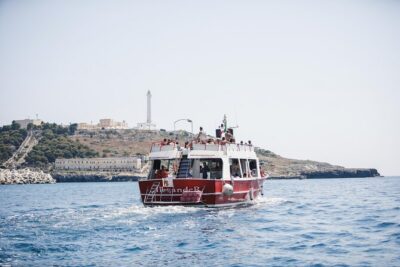
Mini-cruise tour to the Caves of Santa Maria di Leuca
Read our review →Browse the lists this cave appears in