
Review · GUIDED
Narni: Guided underground Experience
History hides beneath Narni’s streets. This $11 underground tour takes you into a former Dominican convent, a 13th-century church, an Inquisition cell, and the remains of the town’s first cathedral. I especially like the mix of real archaeology and multimedia storytelling, plus the chance to see frescoes slowly returning after centuries under limestone. The main drawback is that the live guided visit is only in Italian, so English speakers rely on an audioguide rather than a guide-led explanation.
I also like how much ground this short visit covers. You move from religious art to Roman engineering and then to the darker work of the Holy Office, all within Narni’s historic center. The storytelling can be theatrical, which many people enjoy, though one visitor found some video sections unnecessary and preferred a more serious presentation.
Key things to know before you go
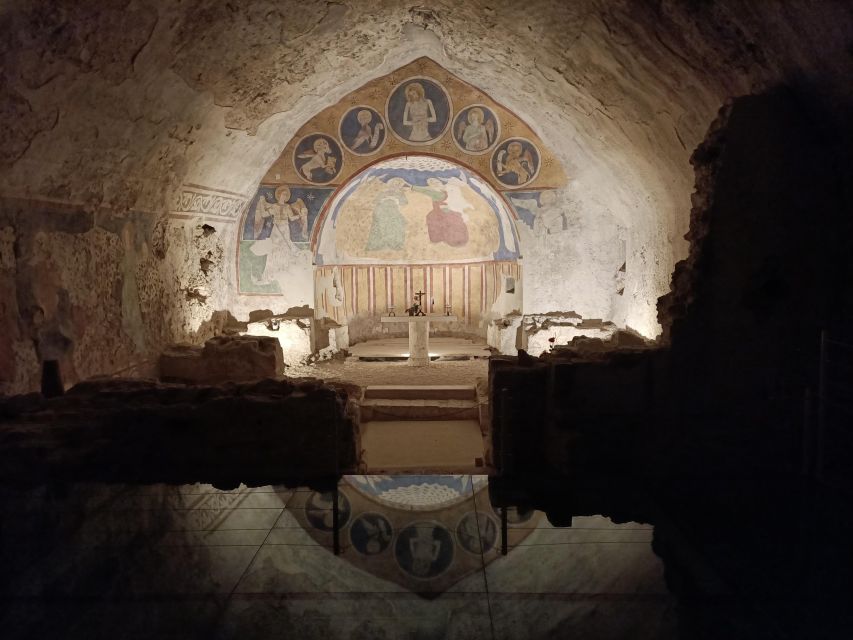
- The entrance is through an ancient underground church: You begin in the striking 13th-century church dedicated to Archangel Michael.
- Roman Narnia appears through an interactive video: You can virtually enter an aqueduct tunnel and see how underground water channels were cut.
- A real Holy Office cell survives: Graffiti left by prisoners gives the dungeon a personal, unsettling edge.
- The upper church contains a Byzantine mosaic: This was part of Narni’s first cathedral and adds an important layer above the underground rooms.
- Italian is the only live tour language: English, French, German, and Spanish are available through audioguides.
- The price is modest for the content: At $11 per person, this is a strong-value stop if you enjoy archaeology, religious art, and local history.
Starting at Via San Bernardo 12
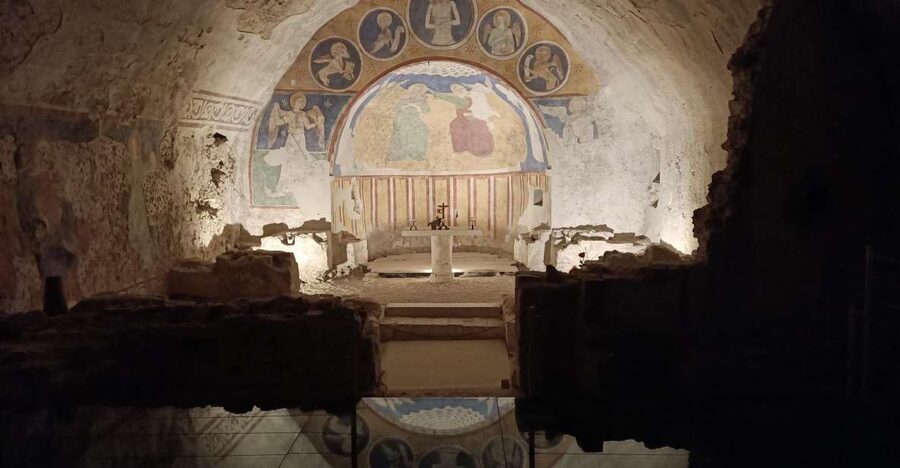
The experience begins at Via S. Bernardo, 12, in Narni. From there, the visit moves through the underground complex and the upper church, with a mix of walking, guided explanation, visual material, and historical interpretation.
The advertised duration is one hour, though the route information also lists about 1.5 hours for the visit. I would allow at least an hour and a half in your schedule, especially if you want time to take in the frescoes, videos, and upper church without rushing.
You enter through a separate entrance, which helps avoid the feel of lining up for a major attraction. Large bags and luggage are not allowed, so arrive with only what you need. The setting is historic and below ground, not a polished modern museum, which is part of the appeal.
More Guided Tours around Italy:
- Naples: Naples Underground Entry Ticket and Guided Tour
★ 4.4 · 21,781 reviews - Naples: Catacombs of San Gennaro Entry Ticket & Guided Tour
★ 4.6 · 7,941 reviews - Naples: Spanish Quarters Underground Guided Tour
★ 4.8 · 5,064 reviews
The underground church of Archangel Michael
The first major stop is the 13th-century underground church dedicated to Archangel Michael. Six young cavers from Narni found the site in 1979, and volunteers have worked on its recovery and improvement ever since.
That volunteer connection matters. You are not simply looking at a finished monument that has been presented in perfect condition. You are seeing a place that had been abandoned, damaged, and gradually brought back into public view.
The church was probably built over older structures and later became part of the Dominican convent in the 14th century. The complex suffered looting in 1860 and was destroyed during World War II. During the long period of neglect, rainwater covered many of the frescoes with limestone.
Today, restoration is slowly revealing those paintings again. I find that more interesting than seeing frescoes that have been scrubbed into a bright, complete display. The partly recovered surfaces show the work of archaeology in progress, and they make the church feel connected to its own long period of silence.
A multimedia system explains the church’s changing phases. You should expect a combination of the actual stonework, visual projections or videos, and spoken interpretation. This approach makes the chronology easier to follow, though it may feel less intimate if you prefer a guide who talks continuously in front of the original objects.
The church was reconsecrated in 2000 under the name St. Mary of the Cliff. The original dedication had not yet been identified at that point, so the later discovery of its connection to Archangel Michael adds another small twist to the site’s story.
Why the multimedia presentation matters
This is not a standard walk from one object to another. The multimedia material helps explain what the rooms may have looked like during different periods and how the complex changed over time.
I think that works best in the underground church, where the architecture has passed through several uses and many surfaces are incomplete. A purely spoken explanation could leave you trying to picture the missing pieces. The videos and projections give you a clearer sense of the site’s phases.
Still, this style will not suit everyone. The visit uses storytelling, gestures, and a touch of theatrical performance. That energy has received strong praise, including enthusiastic comments about a guide named Letizia, who was credited with holding the whole group’s attention through expressive storytelling.
If you prefer a quiet, academic explanation, the performance style may feel excessive. One piece of direct feedback described the guide as well prepared but too theatrical, with some videos viewed as unnecessary. That is a fair warning. The experience is designed to involve you emotionally, not simply deliver dates and architectural terms.
Roman aqueducts beneath ancient Narnia
In the next room, an interactive video explains how aqueducts were excavated in Roman Narnia. You can virtually enter one of the tunnels and see the engineering process without having to squeeze through a real water channel.
This section gives the tour a useful change of pace. The church rooms focus on faith, damage, and restoration. The aqueduct section shifts to practical Roman construction and the way ancient communities managed water below ground.
The virtual tunnel is especially helpful if you have little background in Roman infrastructure. You can see why these channels had to be cut carefully and how much labor was involved in working beneath the city.
The material refers to Roman Narnia, the ancient name for the town. That small change in viewpoint helps connect the modern streets above with the older settlement below. You are not just visiting a religious site. You are tracing how the town used its underground space across different periods.
The presentation is not a substitute for walking through a complete Roman aqueduct system, but it does give the subject a clear place in the tour. If ancient engineering is your main interest, treat this as a well-explained introduction rather than the central attraction.
A few more cave trips around Italy worth a look
- Colosseum: Underground and Ancient Rome Tour
★ 4.7 · 12,691 reviews - Matera: Sassi Tour with Cave House and Rupestrian Church
★ 4.7 · 6,618 reviews - Rome: Capuchin Crypts and Catacombs Tour with Transfers
★ 4.6 · 6,456 reviews - Expert Guided Tour of Colosseum Arena OR Underground, and Forum
★ 4.5 · 5,041 reviews
The Holy Office cell and prisoner graffiti
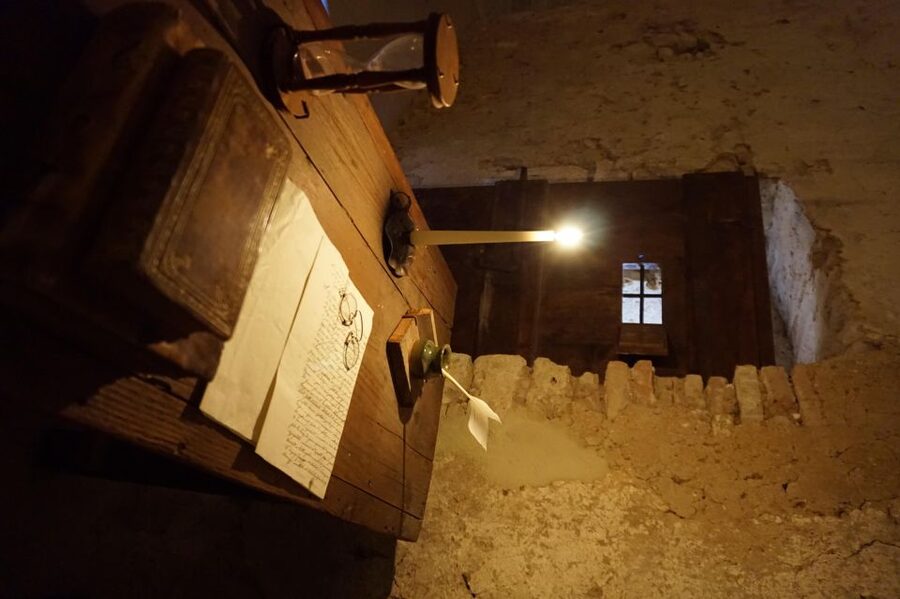
The most unsettling part of the visit is the dungeon of the Holy Office, an institution created to combat heresies. One cell remains intact, and its narrow walls still carry graffiti left by prisoners.
The Vatican Archives helped reconstruct the stories of some people held there. That research gives the room a human scale. Instead of seeing only a dark stone cell, you can connect the space with the people who were confined inside it and left marks behind.
I find prisoner graffiti more affecting than a general account of an old court or prison. A name, line, or scratched message can make the past feel immediate without needing a dramatic reconstruction. The cell is small, and that physical tightness is important. It gives you a direct sense of the conditions described by the historical material.
This section also changes the tone of the experience. The underground church can feel mysterious and beautiful. The dungeon is more severe. Together, the two spaces show how the complex held very different kinds of memory: worship, punishment, restoration, and abandonment.
The presentation may still use dramatic storytelling, so expect an emotional delivery rather than a detached lecture. That will appeal to people who enjoy history told as a human story. If you prefer to form your own interpretation in silence, the guide’s style may occasionally feel like a lot.
The upper church and Narni’s first cathedral
The tour then continues upward to the upper church, identified as the city’s first cathedral. Here, the atmosphere changes again. Instead of focusing mainly on underground rooms and prison history, you see a precious Byzantine mosaic, along with other remains and frescoes.
This final section helps you understand the religious importance of the area. The underground church is not an isolated curiosity. It belongs to a larger complex of sacred buildings and changing uses.
The Byzantine mosaic is one of the clearest reasons to stay engaged through the entire route. It gives the upper church a visual focal point and shows that Narni’s importance reaches back well beyond the Dominican period.
You will also see additional remains and frescoes. Since the restoration process is still revealing some of the painted surfaces, do not expect every artwork to be complete or easy to read. The reward is seeing how conservation works over time, not viewing a perfectly restored gallery.
What the storytelling feels like
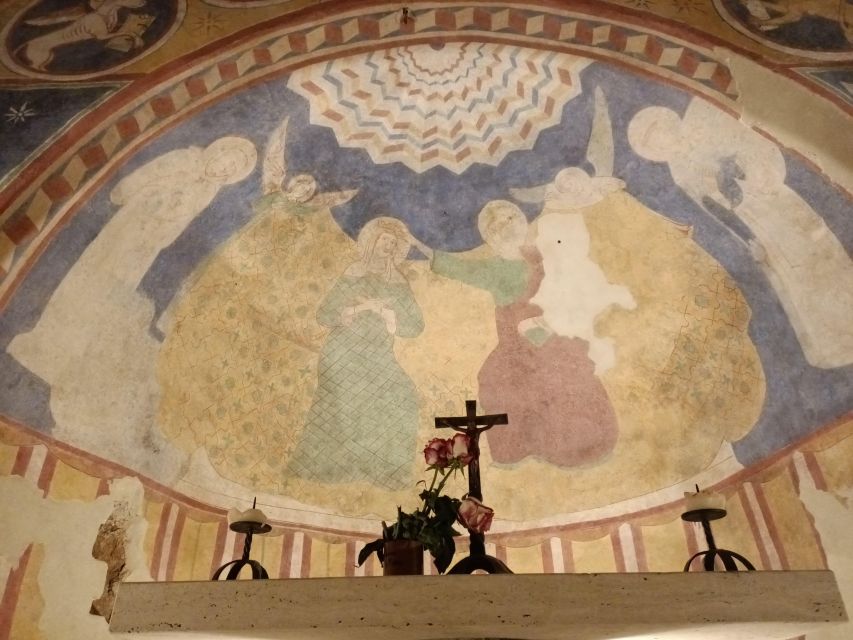
The strongest praise for this experience centers on the guides’ ability to tell the story with energy. Several comments describe the visit as engaging, enthusiastic, and hard to forget. The guide named Letizia received particular praise for using expression and movement to keep the group focused.
That style can turn a compact one-hour visit into something more memorable. The history includes destruction, forgotten rooms, prisoners, and discoveries by young local cavers. A dry presentation would miss some of the drama already built into the site.
At the same time, I would set your expectations correctly. The experience is not a silent archaeological inspection. Videos and theatrical delivery are part of the format. If you like a strong narrative, you will probably find the approach effective. If you want a formal art-history talk, you may prefer to use the audioguide at your own pace, if that option is available during your visit.
The live guided visit is in Italian only. English, French, German, and Spanish audioguides are provided, while groups of at least 20 people can arrange a guided visit in English or Spanish by reservation. Texts are also available in other languages.
Is $11 a good price?
At $11 per person, I consider this good value. The visit combines several distinct subjects: medieval church architecture, restoration work, Roman aqueduct construction, Holy Office history, prisoner graffiti, Byzantine art, and the first cathedral of Narni.
You are not paying only to enter a single room. The fee covers access to a connected historical complex and an organized interpretation of what you are seeing. The separate entrance and reserved access also make the price more useful if you have limited time in Narni.
The main question is language. If you do not understand Italian, the experience depends on how much you enjoy using an audioguide alongside multimedia material. You will still see the physical spaces, but some of the guide’s personality and live storytelling will not carry across in the same way.
The overall rating is 4.6 from 66 reviews, which fits the experience’s main strengths: strong subject matter, engaging storytelling, and a memorable setting. The less enthusiastic response focuses on presentation style rather than the site itself. That distinction is useful. The place is the reliable part. The delivery is a matter of taste.
Who should book this experience?
I would recommend it to you if you enjoy:
- Underground archaeology and unusual historic interiors
- Religious art, frescoes, and Byzantine mosaics
- Roman engineering and ancient aqueducts
- Prison history and personal graffiti
- Short cultural visits with a clear narrative
- Places still being restored and studied
It is also a good choice if you want something different from the usual Umbrian church tour. Narni’s underground spaces add a sense of discovery, while the upper church provides a more traditional cultural finish.
You should think twice if you dislike enclosed historic spaces, multimedia presentations, or theatrical guides. The attraction is also listed as unsuitable for people with mobility impairments. At the same time, the access information says guaranteed access by reservation is available for people using wheelchairs. Because those details conflict, contact the provider before booking if mobility is a concern.
Practical details that affect your visit
The advertised tour duration is one hour, but the route description gives 1.5 hours. I would plan for the longer time so you are not forced to rush to your next stop.
The live tour is in Italian. Audioguides are available in Italian, English, French, German, and Spanish. English and Spanish guided visits can be arranged for groups of at least 20 people by reservation.
Food, drinks, hotel pickup, and hotel drop-off are not included. You also receive a card offering discounts at restaurants in Narni, which can make the visit easier to pair with lunch or dinner in town.
Free cancellation is available up to 24 hours before the visit for a full refund. You can also reserve now and pay later, which is useful if your route through Umbria is still taking shape.
Should you book Narni Underground?
Yes, if you want an atmospheric local-history experience for a modest price. The combination of an abandoned church, recovering frescoes, Roman aqueducts, a surviving prison cell, and a Byzantine mosaic gives you far more variety than the short duration suggests.
Book it with the right expectations. The live explanation is in Italian, the presentation can be theatrical, and the site is not suitable for people with mobility impairments unless access has been confirmed directly. For English speakers, the audioguide is essential.
If those points work for you, this is one of the more distinctive ways to understand Narni. You leave with more than a few old stones in your memory. You see how a place can serve as a church, convent, prison, water system, and archaeological record across many centuries.
FAQ
Where does the Narni underground experience begin?
The experience begins at Via S. Bernardo, 12, in Narni.
How long does the experience last?
The activity is advertised as one hour. The route information also lists about 1.5 hours for the visit, so allow extra time in your schedule.
Is the guided tour available in English?
The live guided visit is only in Italian. Audioguides are available in English, French, German, Spanish, and Italian.
Can groups arrange an English guided visit?
Yes. Guided visits in English and Spanish are available by reservation for groups of at least 20 people.
What are the main sights inside the complex?
You see a 13th-century underground church dedicated to Archangel Michael, Roman aqueduct information, a Holy Office cell with prisoner graffiti, and the upper church with a Byzantine mosaic and other remains.
Are audioguides included?
Yes. Audioguides are included in Italian, English, French, German, and Spanish.
Is the experience suitable for people with mobility impairments?
The activity is listed as not suitable for people with mobility impairments. The access information also mentions wheelchair access by reservation, so contact the provider before booking if you need step-free access.
Can I bring luggage or a large bag?
No. Luggage and large bags are not allowed.
Can I cancel for a full refund?
Yes. You can cancel up to 24 hours in advance for a full refund. You can also reserve now and pay later.
Just added around Italy
- Capri & Blue Grotto: Full-Day Tour with Guided Island Exploration★ 5.0 · 74 reviews
- Private Capri, Anacapri and Blue Grotto Tour from Capri★ 4.5 · 29 reviews
- Private Tour of the Island of Capri by Boat and Visit to the Caves★ 4.5 · 31 reviews
- CAPRI – DIY Day Trip Package – BoatTour, BlueGrotto,Bus&Lunch★ 4.5 · 49 reviews
- Paddleboard in Capri between caves and beaches. Photos included!★ 5.0 · 39 reviews
- Small Group Tour to Blue Grotto, Anacapri and Capri★ 5.0 · 115 reviews
- Blue Grotto and Capri Boat Tour with Aperitivo Swim and Snorkel★ 4.5 · 47 reviews
- Boat Tour of the Caves on the Island of Capri★ 4.5 · 463 reviews
Guided, compared.
Naples Underground Entry Ticket and Guided Tour
Read our review →
Catacombs of San Gennaro Entry Ticket & Guided Tour
Read our review →
Expert Guided Tour of Colosseum Arena OR Underground, and Forum
Read our review →
Colosseum Underground Small Group Guided Tour
Read our review →
Catacombs of St. Callixtus Entry Ticket & Guided Tour
Read our review →
Caves, Beaches, and Secret Spots Guided Kayak Tour
Read our review →Browse the lists this cave appears in