
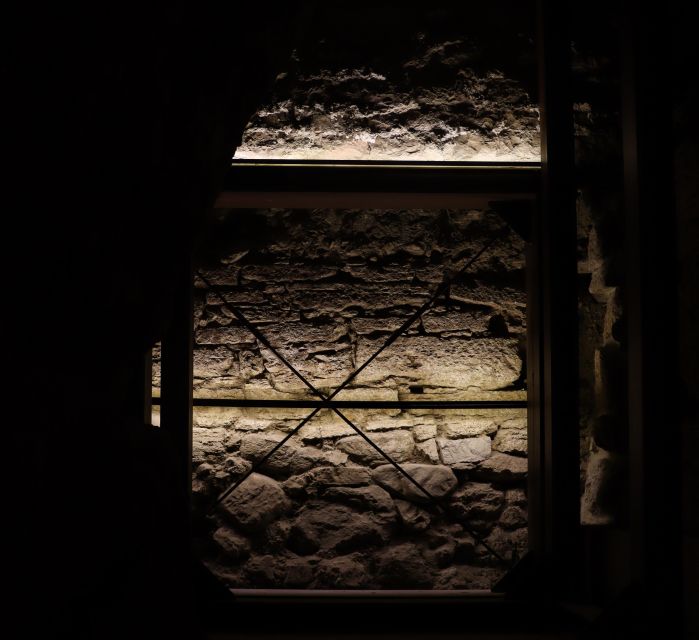
Review · TICKETS
Perugia: Entry Ticket and Guided Tour of Perugia Underground
Perugia has another city below the city. This short guided visit takes you beneath Saint Lawrence Cathedral, where Etruscan, Roman, and medieval remains reveal how Perugia grew over more than 2,500 years. I especially like the layered history and the clever virtual reality finale. The main drawback is that the live guide speaks Italian, so English speakers rely on a tablet and headphones.
The tour is only about 50 minutes, but it covers a lot: ancient construction, Roman streets and houses, medieval changes, and the hill beneath today’s cathedral. Bring a light sweater, and arrive with clear directions in hand, since the meeting point in the cathedral cloister can be easy to miss.
Key points to know before you go
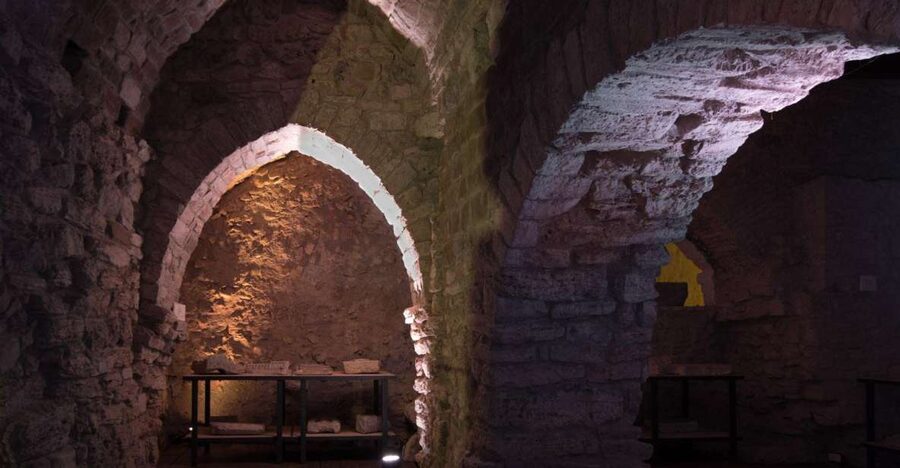
- Fifteen meters below the cathedral: The route reaches far beneath the current level of Saint Lawrence Cathedral.
- Three major periods in one visit: You see Etruscan, Roman, and medieval remains in the same archaeological area.
- Italian-led, with English support: A tablet and headphones provide translated content, but following along can feel rushed.
- A strong visual finish: The included VR experience helps you picture how parts of Perugia looked in the past.
- Short and fairly priced: At $14 per person, the 50-minute visit is a sensible choice for history fans.
- Stairs shape the experience: The route is not suitable for wheelchair users, strollers, or people with significant mobility difficulties.
Entering the Saint Lawrence Cathedral cloister
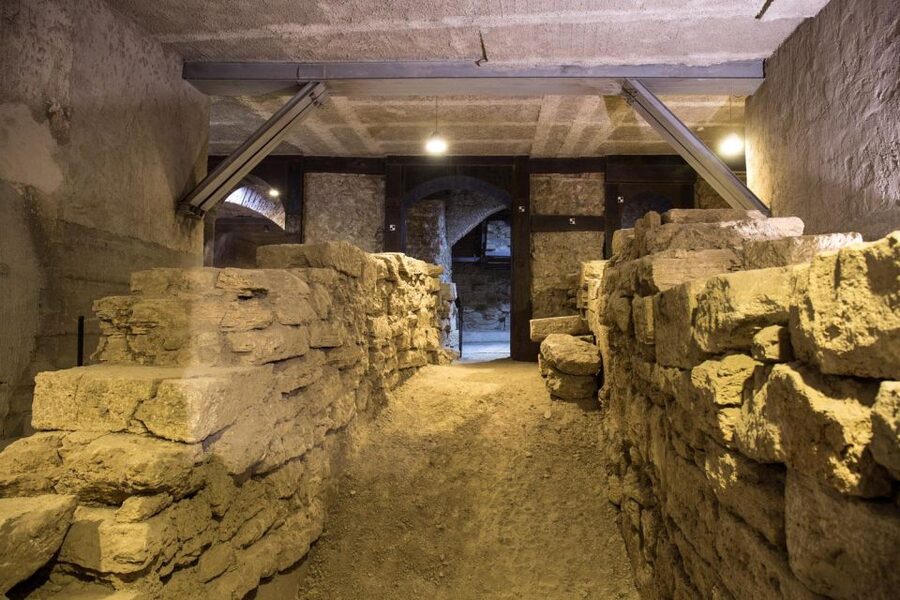
The meeting point is in the cloister of Saint Lawrence Cathedral, accessed through the large portal on Piazza IV Novembre beside Libreria delle Volte. This location matters because the tour begins in the cathedral complex itself, not at a separate archaeological site on the edge of town.
Give yourself time to find the correct entrance. The meeting directions can cause confusion because the ticket office and start point are connected with the cathedral cloister and museum area. One useful tip is to ask for the Perugia Underground ticket office inside the cathedral complex if you do not see the tour immediately.
From the cloister, the experience moves downward into the hill. That change in level gives the visit its basic drama. You are not simply looking at objects in glass cases. You are walking through the built layers beneath the modern city.
The setting also helps explain Perugia. This is a hilltop city that has been altered and rebuilt over centuries. The underground route lets you see those changes physically, with older walls, roads, and foundations appearing below later construction.
More Entry Tickets around Italy:
- Naples: Naples Underground Entry Ticket and Guided Tour
★ 4.4 · 21,781 reviews - Naples: Catacombs of San Gennaro Entry Ticket & Guided Tour
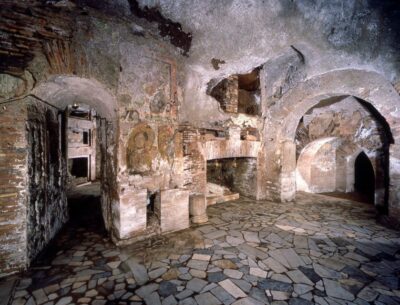
★ 4.6 · 7,941 reviews - Rome: Catacombs of St. Callixtus Entry Ticket & Guided Tour
★ 4.6 · 3,037 reviews
The first layers: Etruscan engineering beneath Perugia
The Etruscan section is one of the most interesting parts of the visit. Perugia’s ancient builders were not working with simple tools and rough plans. The remains show serious construction skill, and the guide explains how the early city was shaped into the hill.
You may see traces of Etruscan structures integrated into later parts of the complex. This is the kind of detail that can be hard to grasp from a history book. Here, the age of the stone and the position of the walls make the city’s long timeline easier to understand.
The tour presents the Etruscans as builders and city planners, not just as a mysterious people who lived before the Romans. That context is valuable. It gives you a better sense of why Perugia’s oldest remains still influence the shape of the city above.
The route reaches about 15 meters below the current cathedral level. That depth is not just a statistic. It shows how much the area has changed as streets, buildings, and public spaces were built higher over time.
The archaeological area is not presented as a single untouched ruin. Instead, it shows fragments from different periods. You will need to pay attention to the guide’s explanations to understand which walls or surfaces belong to which age.
Roman roads, houses, and the siege of Perugia
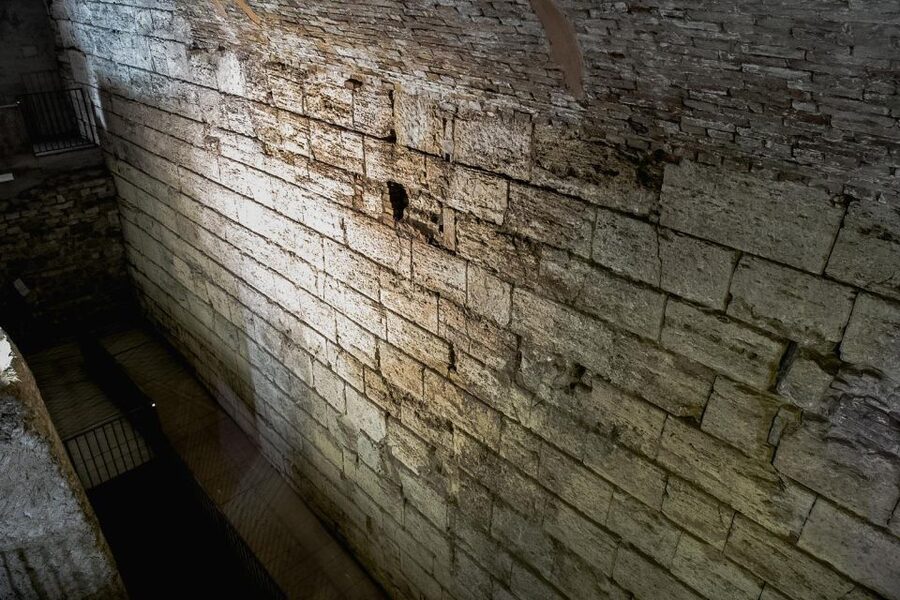
The Roman remains add another strong chapter to the tour. You can see evidence of Roman roads and houses, along with the way Roman building methods shaped the city.
The guide also connects Perugia to Julius Caesar and Gaius Octavius Caesar Augustus. The story includes the siege of Perugia, an event that gives the city’s Roman past more political weight. This is not only a tour about stones and dates. It explains how Perugia was caught up in the struggles that shaped Roman power.
One especially useful feature is the chance to connect archaeological evidence with familiar names. You may know Caesar and Augustus from larger Roman sites, but hearing their names in connection with Perugia helps place this hill town inside the wider Roman world.
The Gate of Augustus is also part of the historical explanation. While the underground route focuses on the Saint Lawrence complex, the broader story links the remains beneath your feet with Perugia’s surviving Roman identity above ground.
This part of the tour is compact, so it does not offer a long archaeological lecture. If you want every construction detail, inscription, and political event explained at length, 50 minutes will feel brief. For a first introduction, though, the pace gives you a useful framework for exploring the city afterward.
Medieval layers below today’s cathedral
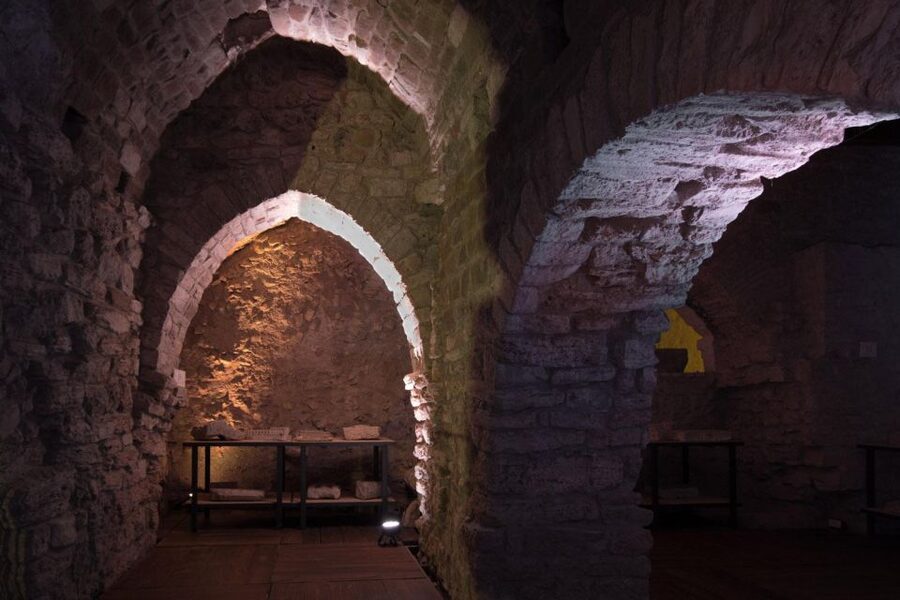
The medieval section shows how the area continued to change after the Etruscan and Roman periods. The underground complex holds evidence of later building phases, with medieval remains appearing alongside much older structures.
That layering is the main reason I would recommend the visit. You are not looking at an isolated ancient ruin. You are seeing Perugia as a place that kept rebuilding itself, often using or covering what came before.
The route beneath Saint Lawrence Cathedral makes this especially clear. The present religious complex sits above earlier remains, so the visit turns the cathedral into more than a beautiful building on the piazza. It becomes the latest visible chapter in a much older story.
Your guide helps connect the sections, and the Italian-led presentation is often praised for its energy and warmth. Beatrice has been singled out for making the underground layers easy to follow, while Lorenzo has been praised for his clear explanations and helpful approach.
Because the tour is guided only, you cannot simply wander at your own pace. That is useful for understanding the site, but it also means the group must keep moving. A few people have found the route slightly rushed, especially when trying to listen, read translated material, and look closely at the remains at the same time.
More Guided Tours around Italy:
- Naples: Spanish Quarters Underground Guided Tour
★ 4.8 · 5,064 reviews - Expert Guided Tour of Colosseum Arena OR Underground, and Forum
★ 4.5 · 5,041 reviews - Rome: Colosseum Underground Small Group Guided Tour
★ 4.7 · 4,844 reviews - Colosseum Underground & Ancient Rome Guided Tour
★ 4.5 · 2,590 reviews
The Italian guide and English tablet
The live tour is in Italian. If you understand Italian, you will get the full benefit of the guide’s explanations, timing, and interaction with the group.
For other languages, a tablet with translated content and headphones is provided when needed. English speakers can follow the information, but this arrangement is not quite the same as having a live English-speaking guide.
The tablet lets you access the main explanations, but it creates a practical problem. You may be reading while the guide has already moved to the next section. One English-speaking visitor found the translated recording slower than the Italian presentation, which made it necessary to skip ahead.
You also have to manage the device while walking through the site. That can make it harder to take photographs or simply look around. If you want an easy, relaxed visit with plenty of time to study every wall, the translation system may feel a little busy.
Still, the English option makes the tour accessible to visitors who do not speak Italian, and the historical content remains useful. My advice is to focus first on the physical remains, then use the tablet for the main points rather than trying to read every word in real time.
Why the virtual reality finale works
The VR experience comes at the end and is one of the most praised parts of the visit. It gives you a visual idea of how the underground area or parts of the city may have looked in earlier periods.
This is helpful because archaeological remains can be hard to picture. A low wall or worn surface may be important, but it takes imagination to turn it into a complete street, building, or urban scene. The headset supplies that missing visual step.
Some visitors would prefer the VR presentation at the beginning, since it would provide a broad picture before the detailed walk. I understand that point. Seeing the reconstruction first could help you recognize the meaning of each section as you move through it.
Even so, placing it at the end has a benefit. You first see the actual remains, hear the history, and then receive a visual recap. The final presentation can tie together the Etruscan, Roman, and medieval stages in a way that ordinary labels cannot.
The technology is also a good fit for a short tour. It adds something memorable without requiring a second long visit. If you enjoy museums with audiovisual features, this will likely be a highlight. If you prefer a strictly traditional archaeological tour, it may feel more entertaining than essential, but it still adds useful context.
How much time and value you get for $14
At $14 per person, this is good value for a central Perugia activity. The ticket includes the archaeological entrance, the guided tour, the translation tablet when needed, and the VR experience.
The visit lasts about 50 minutes. That is long enough to introduce the site without taking half a day from your time in Perugia. You can fit it between other sights around Piazza IV Novembre, although you should allow extra time to locate the cloister and ticket office.
The price works best if you already plan to explore Perugia on foot. The underground visit gives you historical context for the cathedral area, the old city streets, and other remains you may encounter afterward.
It is not a full archaeological museum visit. One person wanted to see more objects found during the excavations, and another found the museum portion rushed at the end. If you are looking for a large display of artifacts, this is not the right primary attraction.
Instead, you are paying for access to the underground route and for someone to explain what you are seeing. At this price, that is a fair exchange, particularly because the VR segment is included rather than sold as an extra.
Practical details that affect your visit
Wear comfortable shoes and expect several flights of stairs. The route is not suitable for wheelchair users, strollers, or people with significant mobility difficulties. Pets, food, and drinks are not allowed.
The temperature underground is slightly different from the piazza above. A light garment is a sensible addition, especially if you are visiting during warm weather.
The tour is available with free cancellation up to 24 hours before the scheduled visit, and you can reserve now and pay later. These options are useful if your route through Umbria is still changing.
The live language is Italian. If you need another language, check that the tablet translation is available for your visit. English support is provided through the device, not through a live English-speaking guide.
The site is in the heart of Perugia, so the main challenge is finding the correct entrance rather than reaching a remote attraction. Look for the large portal on Piazza IV Novembre next to Libreria delle Volte, then confirm that you are in the Saint Lawrence Cathedral cloister.
Who should book Perugia Underground?
I would choose this tour if you want a concise explanation of Perugia’s origins and enjoy seeing history in place rather than only in a museum. It suits first-time visitors, history fans, and anyone curious about how an Italian hill town developed over many centuries.
It is also a good choice before visiting other parts of Perugia. The underground route can help you understand the city’s built layers, and it provides useful background for seeing the Rocca Paolina on your own.
You may want to skip it if stairs are difficult, if you dislike guided group visits, or if you need a fully live tour in English. The tablet system works, but it asks you to read and listen at the same time.
For most able-bodied visitors, the $14 price is easy to justify. The tour is short, the location is central, the guide adds essential context, and the VR finale gives the experience a clear finish. I would book it as a focused introduction to Perugia, not as a replacement for exploring the city above ground.
FAQ
Where does the Perugia Underground tour begin?
The ticket office and meeting point are in the cloister of Saint Lawrence Cathedral. Enter through the large portal on Piazza IV Novembre, next to Libreria delle Volte.
How long does the tour last?
The tour lasts about 50 minutes.
How much does the experience cost?
The listed price is $14 per person.
What languages are available?
The live tour is in Italian. A tablet with translated content and headphones is provided when needed.
Is the entrance ticket included?
Yes. The price includes admission to Perugia Underground and the guided tour.
Is the virtual reality experience included?
Yes. The VR experience is included and takes place at the end of the visit.
Can I bring a stroller?
No. Baby strollers are not allowed, and the route includes stairs.
Is the tour suitable for wheelchair users?
No. The route is not suitable for wheelchair users or people with significant mobility difficulties.
Can I cancel my booking?
Yes. You can cancel up to 24 hours in advance for a full refund. You can also reserve now and pay later.
Just added around Italy
- Capri & Blue Grotto: Full-Day Tour with Guided Island Exploration★ 5.0 · 74 reviews
- Private Capri, Anacapri and Blue Grotto Tour from Capri★ 4.5 · 29 reviews
- Private Tour of the Island of Capri by Boat and Visit to the Caves★ 4.5 · 31 reviews
- CAPRI – DIY Day Trip Package – BoatTour, BlueGrotto,Bus&Lunch★ 4.5 · 49 reviews
- Paddleboard in Capri between caves and beaches. Photos included!★ 5.0 · 39 reviews
- Small Group Tour to Blue Grotto, Anacapri and Capri★ 5.0 · 115 reviews
- Blue Grotto and Capri Boat Tour with Aperitivo Swim and Snorkel★ 4.5 · 47 reviews
- Boat Tour of the Caves on the Island of Capri★ 4.5 · 463 reviews
Tickets, compared.
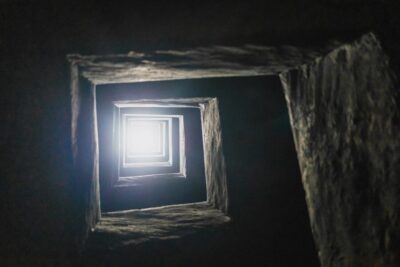
Naples Underground Entry Ticket and Guided Tour
Read our review →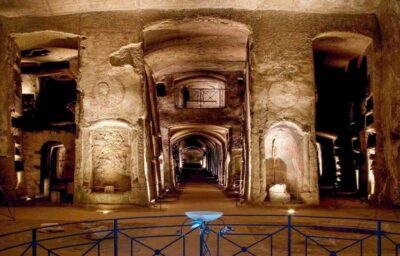
Catacombs of San Gennaro Entry Ticket & Guided Tour
Read our review →
Catacombs of St. Callixtus Entry Ticket & Guided Tour
Read our review →
Postojna Cave & Predjama Castle Tickets and Tour
Read our review →
Caves of San José Guided Excursion and Ticket
Read our review →
Nerja: Caves of Nerja Entry Ticket with Audio Guide
Read our review →
Tour to Chichen Itza-Tickets, food and cenote
Read our review →Browse the lists this cave appears in