Review · CATACOMBS & UNDERGROUND CITY TOURS
Appian Way, Catacombs and Aqueducts Park Tour with Top E-Bike
Rome’s ancient outskirts reward a slower ride. This e-bike tour links the Appian Way, Roman catacombs, imperial ruins, and the Aqueducts Park in one well-planned outing. I like the way the electric bike makes a wide route manageable, and I especially like the small groups, capped at 10 people, which give guides such as Arina, Fabio, Claudia, and David room to explain what you are seeing.
The main consideration is that this is not a casual spin. You cover about 17 miles, with 60 percent off-road and roughly 40 percent on city streets. Confident cyclists will have the best time, while anyone uneasy on a bike, or dealing with back or neck problems, should think carefully before booking.
Key points to know before booking
- The six-hour version adds the best extras: a 45-minute guided catacomb visit, Villa dei Quintili, and the Baths of Caracalla.
- The e-bike reduces effort, not responsibility: you still need to handle narrow paths, bumpy surfaces, pedestrians, and some traffic.
- The route reaches places that are awkward on foot: the Appian Way and Aqueducts Park are spread far beyond central Rome.
- Small groups make a real difference: the maximum is 10 people, and guides can keep a closer eye on the group.
- Wednesday follows a different plan: the route can run 30 minutes longer, with San Sebastiano Catacombs replacing San Callixtus on the six-hour tour.
- Bring water and a snack: food is not included, though the route offers a few chances to buy something.
Why an e-bike makes the Appian Way practical
The Appian Way is not one isolated monument. It is a long corridor of ancient roads, tombs, ruins, open fields, and side parks stretching beyond the main tourist center. Walking lets you see only a small section before the distance and heat begin to wear you down.
That is where this tour earns its price. The electric-assist bike helps you cover ground without turning the day into an endurance test. You can still pedal for exercise, or let the motor handle much of the work, but you must remain alert and in control.
The bikes are described as high-quality models with puncture-resistant tires. A helmet is mandatory and supplied at no extra cost, along with a front bag and biodegradable water bottle. Equipment has a weight limit of 300 pounds, or 136 kilograms.
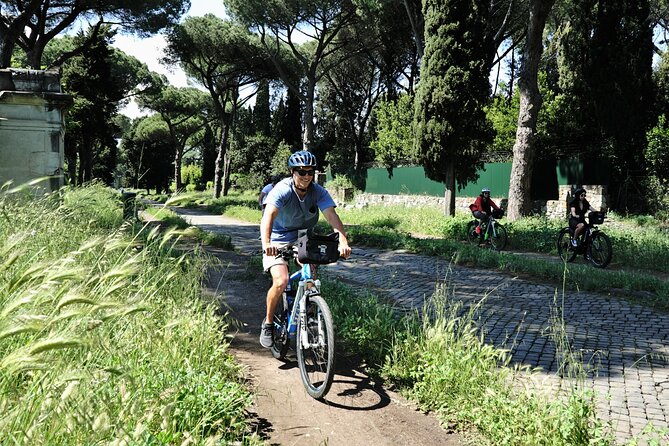
The ride is not designed for someone who has never ridden before. Some roads are tight, some surfaces are rough, and the group occasionally shares city streets with traffic. The tour follows carefully chosen routes, and 60 percent of the ride is away from traffic in parks, but safe does not mean effortless.
More Catacombs and Underground City Tours in Italy
- Rome: Capuchin Crypts and Catacombs Tour with Transfers
★ 4.6 · 6,456 reviews - The Original Roman Crypts and Catacombs Tour with Transfers
★ 4.5 · 4,896 reviews - Rome: Catacombs of St. Callixtus Entry Ticket & Guided Tour
★ 4.6 · 3,037 reviews
From Via Labicana to Porta San Sebastiano
You meet at Via Labicana 49, a central location near public transportation. After a bike fitting and safety briefing, the group leaves the city center and heads toward Porta San Sebastiano.
This gate is part of Rome’s third-century Aurelian Walls. It is a fitting entrance to the day because the tour quickly shifts from modern Rome to the city’s ancient edge. The first section takes place on city streets, so you should expect careful riding rather than a fast, open-road cruise.
The route is usually taken at a controlled pace. That helps the guide keep 10 riders together, though one criticism of the experience was that the group sometimes moved too slowly. If you prefer to ride independently or at speed, a self-guided rental may suit you better.
The Appian Way changes character
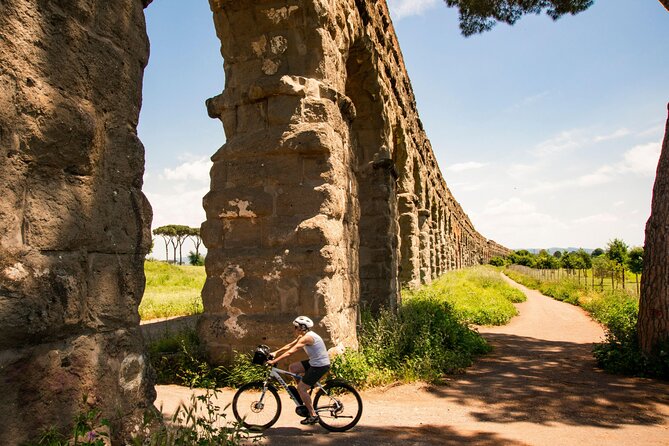
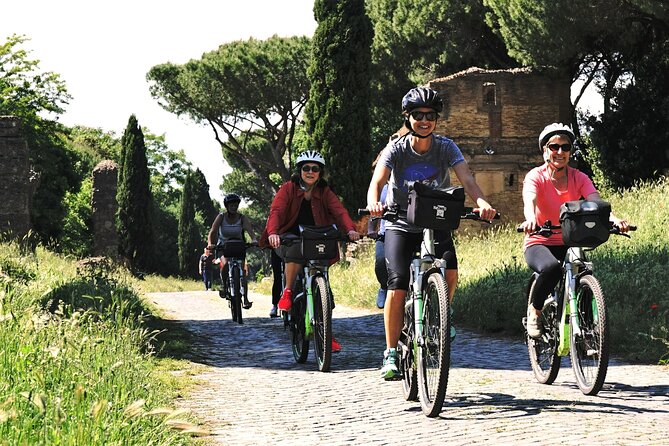
The Ancient Appian Way begins as a fairly ordinary Roman street, then gradually feels older and more secluded. In the Appian Way Park, the setting opens into fields, low hills, and quiet paths where sheep may graze outside the city.
This change is one of the strongest parts of the outing. You get a view of Rome that the Colosseum and Vatican cannot provide: not just famous buildings, but the old road network and countryside that supported the empire.
The ancient road can be uneven. Expect bumps, narrow stretches, and moments when taking photographs while riding is not sensible. The route provides photo opportunities, but you may wish there were more planned stops. Keep your camera put away until the guide gives you time to pause.
Weekday timing is worth considering. Sundays can bring more local walkers and cyclists to the Appian Way and Aqueducts Park, making the ride more crowded and requiring extra concentration. A weekday should provide a calmer experience when your schedule allows.
Catacombs of San Callixtus and San Sebastiano
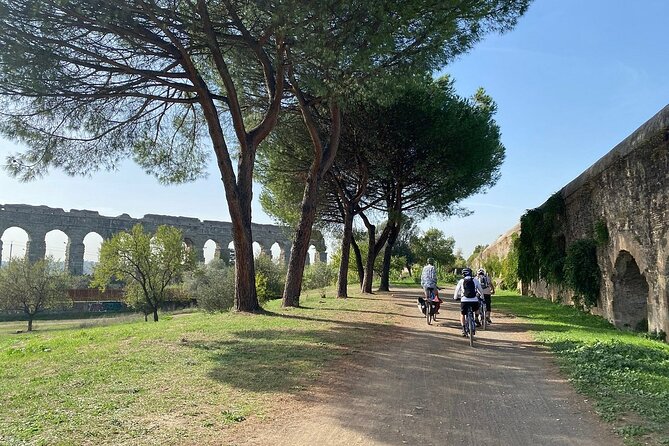
The catacombs add a completely different mood. San Callixtus began in the second century and became an enormous underground burial complex, associated with the resting places of hundreds of thousands of people.
The four-hour tour includes a short pause at the catacombs rather than the longer guided visit. That option works if your priority is seeing a broad collection of sites within a half-day. It does not give you as much time underground, so the six-hour version is the better choice if the catacombs are central to your plans.
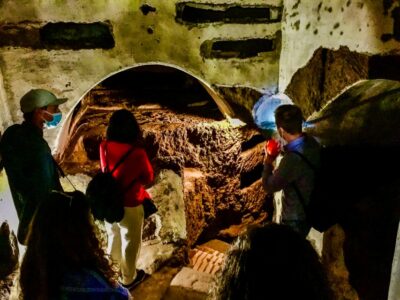
On the six-hour tour, the catacomb visit lasts about 45 minutes and is guided. You see the underground passages and burial chambers while learning how the complex developed and why it mattered to early Christian Rome.
On Wednesdays, the six-hour tour visits the Catacombs of San Sebastiano instead of San Callixtus. The four-hour route does not include the catacomb stop on Wednesdays. The Wednesday route can also run about 30 minutes longer, so leave extra room in your schedule.
One practical caution comes from the setting itself. The catacombs are underground and can feel confined. If enclosed spaces trouble you, the short version may be a better compromise, or you may prefer the route without an extended subterranean visit.
More Catacombs and Underground City Tours in Rome
- Rome: Guided Roman Catacombs Tour with Transfers
★ 4.6 · 1,830 reviews - Rome: Catacombs Guided Tour with Transfer
★ 4.2 · 1,808 reviews - Rome EBike Tour: Appian Way, Catacombs & Roman Aqueducts
★ 5.0 · 1,766 reviews - Rome: Catacombs and Capuchin Crypt Guided Tour with Transfer
★ 4.6 · 1,606 reviews
Circus of Maxentius and Cecilia Metella
The next section brings you past the remains of the Circus of Maxentius, part of a fourth-century imperial complex that also included a villa and mausoleum. The circus was built for chariot racing, and its surviving form helps you picture how large these imperial estates once were.
You then reach the Mausoleum of Cecilia Metella and the Castrum Caetani. The mausoleum is one of the largest and best-preserved monuments along the Appian Way, dating to the first century AD.
The stop itself is brief, listed at about five minutes, so do not expect a long archaeological visit here. The value comes from seeing the monument in its original setting, along the old road, rather than viewing it as a detached object in a museum.
The guides are an important part of this section. People who rode with Stefan, Zac, Bita, Ali, and Christian singled out their ability to explain landmarks while keeping the ride organized. A strong guide helps you understand why a ruin matters without forcing you to stop for a lecture at every turn.
The six-hour route reaches Villa dei Quintili
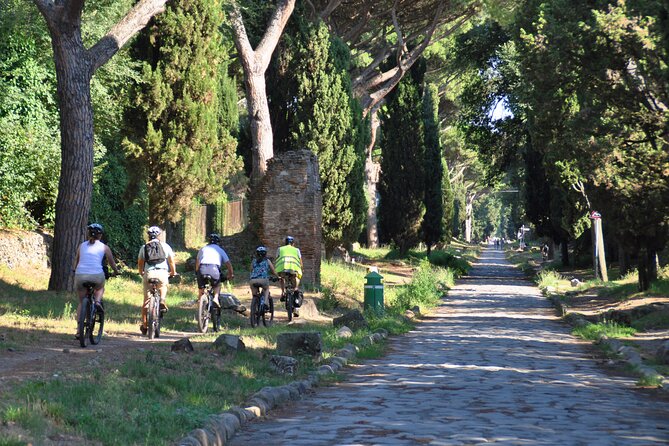
The longer tour adds Villa dei Quintili and Santa Maria Nova. This large second-century villa complex belonged to two wealthy brothers who lived during the Roman imperial period.
The site gives the six-hour route a broader sense of Roman life. The Appian Way was not only a military and commercial road. It also served as an address for elite country residences, grand estates, and memorials.
The listed stop is short, about five minutes, so the tour is not a full archaeological exploration of the villa. Still, reaching it by bike adds useful context to the road itself. You see how the monuments and estates spread across the countryside rather than clustering in central Rome.
If you have only one free afternoon, the four-hour version covers the essential route. If you have more than a day or two in Rome and want ancient sites beyond the standard circuit, I would choose six hours.
Aqueducts Park and the open Roman countryside
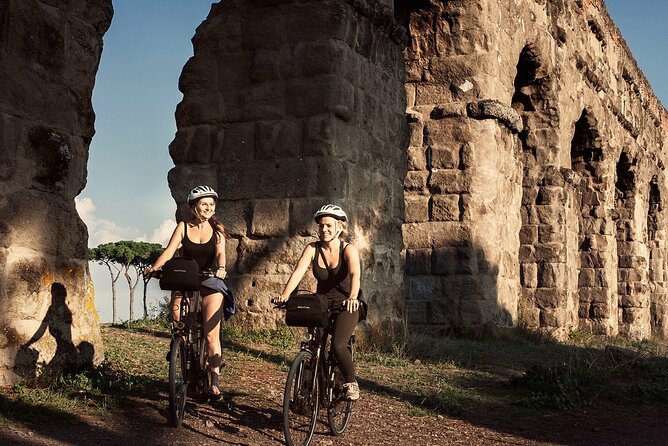
At the Aqueducts Park, huge arches cross the open fields. These structures were part of Rome’s water system, which carried supplies through underground channels and raised aqueducts into the city.
The scale is the point. Unlike a small ruin that asks you to study details up close, the aqueducts make sense from a distance. You can see the long lines of arches against the sky and understand how much engineering and labor Rome invested in water.
The park also provides a welcome change from city streets. The route passes through open valleys and low hills, with sheep grazing nearby. For many people, this is the most peaceful part of the day, and it offers some of the strongest photographs.
You can buy food or drinks at a few points along the route, but nothing is included. Bring a snack, especially for the six-hour outing, and ask your guide when a suitable break is coming. A picnic near the aqueducts is possible if you plan ahead and purchase supplies.
The Baths of Caracalla on the longer tour
The six-hour route ends its ancient-site sequence with a view of the Baths of Caracalla. These enormous thermal baths show how central bathing was to Roman social life, not merely a private act of washing.
The tour gives you a good vantage point rather than a full interior visit. That distinction matters. If you want to explore the Baths of Caracalla room by room, you would need a separate admission and visit, but this stop still puts the complex into the wider story of Roman public life.
The short stop also helps explain why the six-hour tour is packed. You see more places, but many are brief viewing stops rather than long visits. Choose it for range and variety, not for a slow archaeological study of each site.
The ride itself: easy on the legs, demanding on attention
The e-bikes received strong praise for being easy to use and well maintained. They are especially useful for families with older children and for adults in average condition who worry about the distance.
Children aged nine and older may ride their own appropriately sized e-bike. Children aged five to eight can use a child extension, but the operator describes the route as difficult with a child seat or extension mounted. That is a serious point, not fine print. The uneven paths and city connections are much harder when carrying a child.
The tour is a good fit for teenagers. Several families found that the combination of movement, open space, and ancient sites held their attention better than a long indoor museum visit. An 11-year-old and a 16-year-old can enjoy the outing, but the younger rider must be comfortable on a bicycle.
The group size is limited to 10, which is small enough for the guide to monitor riders and answer questions. It also means that the group may move at the pace of its least confident cyclist. One person reported riding around six miles per hour and feeling that the pace was too slow. That is the tradeoff for staying together safely.
Rain can also change the tone of the day. A group caught in a rainstorm still enjoyed the ride, but you should not book this as a weather-proof activity. Check the forecast and wear clothing that can handle changing conditions.
How much value do you get for $102.79?
At $102.79 per person, this is not the cheapest way to rent a bicycle in Rome. You are paying for the bike, helmet, equipment, guide, route planning, and, in the six-hour version, the guided catacomb visit.
The value is strongest if you want to combine several scattered sites in one outing. Reaching the Appian Way, catacombs, Villa dei Quintili, Aqueducts Park, and Baths of Caracalla independently would involve a mix of walking, public transportation, taxis, and careful route planning.
The price is less compelling if you mainly want free time to ride. The guide controls the pace and schedule, and the group cannot simply stop whenever one rider wishes. A self-rented e-bike offers more freedom, but it does not provide the same historical explanation or organized connection between the sites.
I would spend the extra money on the six-hour version if you have the stamina and time. The guided catacomb visit alone makes the longer option more complete, and Villa dei Quintili and the Baths of Caracalla add useful variety.
Choosing four or six hours
Choose the four-hour ride if you want:
- A substantial half-day outside central Rome
- The Appian Way and Aqueducts Park
- A brief catacomb-related stop, when offered
- Less time in the saddle
- A lower physical and scheduling commitment
Choose six hours if you want:
- A guided 45-minute catacomb visit
- Villa dei Quintili and Santa Maria Nova
- The Baths of Caracalla
- A fuller picture of Rome beyond the center
- Better value from the guide and equipment
Both versions cover about 27 kilometers and include city riding and off-road sections. The longer tour adds places and time, but it does not remove the need for bike confidence.
Who should book this Rome bike tour?
I would recommend it to active visitors who have already seen, or plan to see, Rome’s main center and want something different. It is especially good for families with teenagers, couples who enjoy outdoor sightseeing, and anyone interested in ancient engineering, roads, burial sites, and Roman daily life.
It is also a smart choice if your walking plans are already full. The e-bike lets you reach a broad area without spending the whole day on foot, though you still need moderate fitness and steady bike skills.
I would hesitate to recommend it to novice cyclists, anyone uncomfortable near traffic, or anyone with significant back or neck problems. The route is carefully planned, but narrow paths, bumps, pedestrians, and urban connections are part of the experience.
Confirmation arrives at booking, and free cancellation is available up to 24 hours before the start time. The tour requires at least four participants, so a small booking may be canceled if the minimum is not reached, with an alternative or full refund offered.
FAQ
How long is the Appian Way e-bike tour?
The tour lasts approximately four to six hours. On Wednesdays, and from January 14 through February 11, 2026, the route may take about 30 minutes longer.
What is included with the e-bike tour?
The price includes a high-quality e-bike with puncture-resistant tires, a local guide, a helmet, a front bag, and a biodegradable water bottle. A guided catacomb visit is included only with the six-hour version.
How much of the route is off-road?
About 60 percent of the 17-mile, or 27-kilometer, route takes place off-road in parks. The remaining 40 percent uses carefully selected city streets, where some traffic is unavoidable.
Can children join the tour?
Children aged five to eight can use a child extension. Children aged nine and older can ride their own appropriately sized e-bike. The route is considered difficult with a child seat or extension, and children should already feel confident on a bicycle.
What happens on Wednesdays?
The four-hour tour does not include the catacomb stop on Wednesdays. The six-hour tour visits the Catacombs of San Sebastiano instead of San Callixtus, and both tours may last about 30 minutes longer.
Is food included?
No. Food and drinks are not included, though the route offers a few chances to purchase them and take a suitable break.
Should you book it?
Book this tour if you want to see Rome’s ancient outskirts as connected places rather than isolated ruins. The small group, strong guides, capable e-bikes, and wide route make it one of the better ways to reach the Appian Way and Aqueducts Park in one day.
Choose the six-hour option if the catacombs matter to you. Pick a weekday if possible, and come ready for bumps, traffic, and a steady ride. If you are not confident on a bike, skip the tour rather than hoping the electric motor will solve the problem.
More E-Bike Rides around Rome
- Rome: Appian Way & Catacomb Sunset E-bike Tour with Aperitif
★ 4.5 · 682 reviews - Rome: Appian Way, Catacombs & Aqueducts by eBike + Transfer
★ 4.9 · 421 reviews - E-Bike Mountain Tour in Natural Park +Option Tapas in a Cave
★ 4.7 · 63 reviews
More Cycling Tours around Rome
- Rome: Appian Way & Aqueducts E-Bike Tour (Catacombs & Food)
★ 4.9 · 1,498 reviews - Rome: Appian Way, Catacombs, & Roman Aqueducts E-bike Tour
★ 4.9 · 1,421 reviews - Appian Way Aqueducts Bike Tour (Catacombs & Lunch Option)
★ 5.0 · 975 reviews - Rome: Appian Way E-Bike Tour Catacombs, Aqueducts & Picnic
★ 4.6 · 727 reviews
Just added around Rome
- Explore Christian Rome and the Underground of San Clemente★ 4.4 · 16 reviews
- Rome: Colosseum Underground and Arena Floor Tour★ 4.4 · 59 reviews
- Rome: Exclusive Colosseum Underground and Roman Forum Tour★ 4.8 · 569 reviews
- Catacombs of Saint Agnes Entry Ticket & Guided Tour★ 4.5 · 72 reviews
- From Rome: Capri Guided Day Trip with Blue Grotto★ 4.2 · 199 reviews
- Rome: Appian Way, Catacombs & Aqueducts by eBike + Transfer★ 4.9 · 421 reviews
- Private Guided Tour of Colosseum Underground OR Arena and Forum★ 5.0 · 111 reviews
- Private Tour of Catacombs and Ancient Appian Way (hotel pick up)★ 4.5 · 120 reviews
Catacombs & Underground City Tours, compared.
Catacombs of San Gennaro Entry Ticket & Guided Tour
Read our review →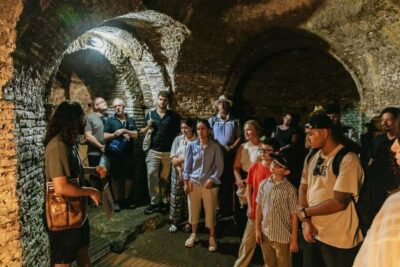
Capuchin Crypts and Catacombs Tour with Transfers
Read our review →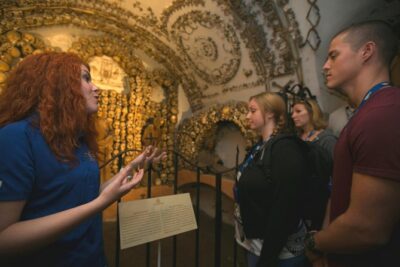
The Original Roman Crypts and Catacombs Tour with Transfers
Read our review →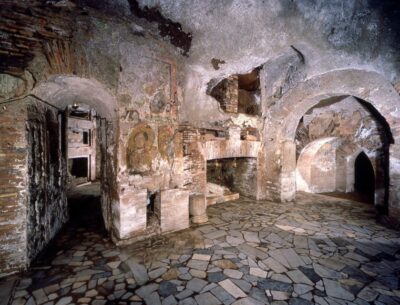
Catacombs of St. Callixtus Entry Ticket & Guided Tour
Read our review →

Full Day Cappadocia Tour( Red Tour + Underground City )
Read our review →