Review · CATACOMBS & UNDERGROUND CITY TOURS
Rome: Appian Way, Catacombs, & Roman Aqueducts E-bike Tour
Rome rewards you beyond the city center. This e-bike ride links the ancient Appian Way, Roman tombs, the Catacombs, and the towering Aqueducts Park in one long outing. I especially like the mix of quiet countryside and major Roman landmarks, plus the quality Cannondale e-mountain bikes that make the 27-kilometer route manageable. The main consideration is that this is an intermediate ride, with rough ground and some traffic on city streets.
I also like the small groups, limited to 10 people, and the careful road work provided by guides such as Arina, Oscar, Agnese, and Bita. The 6-hour version adds a guided Catacomb visit, while the 4-hour trip keeps the underground stop brief. If you are not comfortable handling a bike on gravel, uneven paths, and urban roads, the shorter option will not remove every challenge.
Key points before you book

- Two tour lengths: Choose the 6-hour route with a guided Catacomb visit, or the 4-hour version without the underground tour.
- A 27-kilometer ride: About 60 percent of the route is off-road, with the rest using selected city streets.
- Quality electric mountain bikes: Cannondale e-bikes with anti-puncture tires provide strong assistance on climbs and long stretches.
- Rome beyond the crowds: The route reaches the Appian Way, Circus of Maxentius, Villa dei Quintili, Aqueducts Park, and Caffarella Park.
- Small-group safety: Groups are limited to 10, and guides take special care at traffic crossings and busy road sections.
- A real bike outing: You still need decent bike control, especially on bumpy ground and in traffic, even with electric assistance.
Why this route is different from central Rome

Most first visits to Rome revolve around the Colosseum, Roman Forum, Pantheon, and Vatican. Those places deserve their fame, but they also bring crowds, queues, and a steady stream of tour groups.
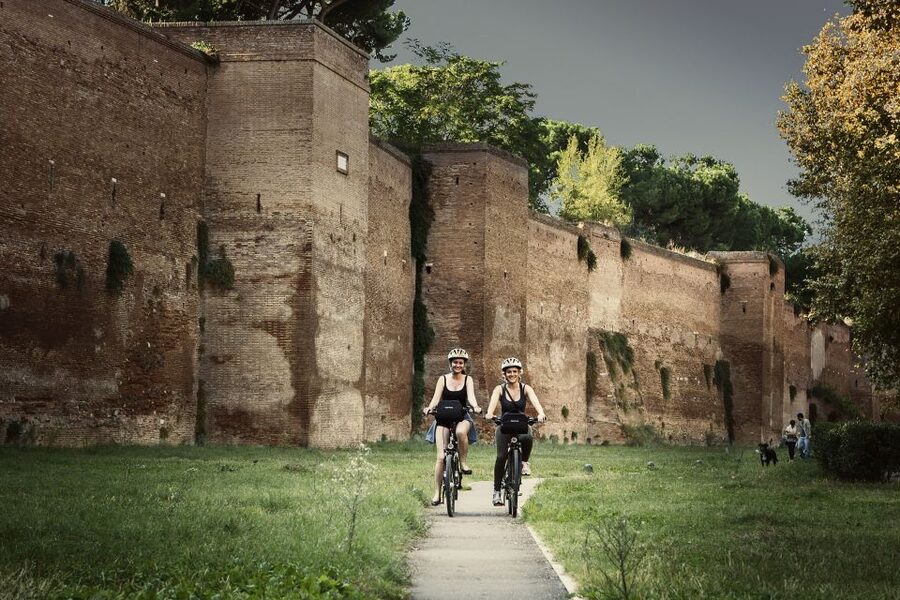
This ride takes you through a quieter side of the city. You begin near the Colosseum at Via Labicana 49, then pedal toward the Aurelian Walls and the old southern road network. Before long, stone ruins replace busy urban streets, and the city starts to feel far away.
The route connects several sites that are often treated as separate day trips. You see the Appian Way, ancient burial monuments, the Catacombs, Roman villas, aqueducts, and the Caffarella Valley without arranging several transfers. That is the chief value here: the bike itself becomes your transport between Rome’s scattered outdoor sites.
You will not spend the full day on traffic-free paths. About 40 percent of the ride is in the city, and traffic is unavoidable in places. Still, the route uses carefully selected streets, and the larger share takes place in parks or on the Appian Way.
More Catacombs and Underground City Tours in Italy
- Rome: Capuchin Crypts and Catacombs Tour with Transfers
★ 4.6 · 6,456 reviews - The Original Roman Crypts and Catacombs Tour with Transfers
★ 4.5 · 4,896 reviews - Rome: Catacombs of St. Callixtus Entry Ticket & Guided Tour
★ 4.6 · 3,037 reviews
Starting at Via Labicana 49
The meeting point is easy to reach from either the Colosseum or Manzoni Metro station. From the Colosseum, allow about 10 to 15 minutes on foot. Walk past the Colosseum along Via Labicana, and number 49 is on the right.
From Manzoni, the walk takes about 10 minutes. Follow Viale Manzoni toward the Colosseum until it becomes Via Labicana. Number 49 is on the left.
Allow enough time to arrive without rushing. You will need to check in, receive your helmet and handlebar bag, and get familiar with the e-bike controls. The helmet is required, and the 5-liter handlebar bag is useful for small personal items.
The bikes are Cannondale electric mountain bikes with anti-puncture tires. That matters on this route, since parts of the ride use gravel and uneven surfaces. Several riders found the bikes easy to use, including first-time e-bike users, but the electric motor does not replace basic steering and braking skills.
Passing through the Aurelian Walls
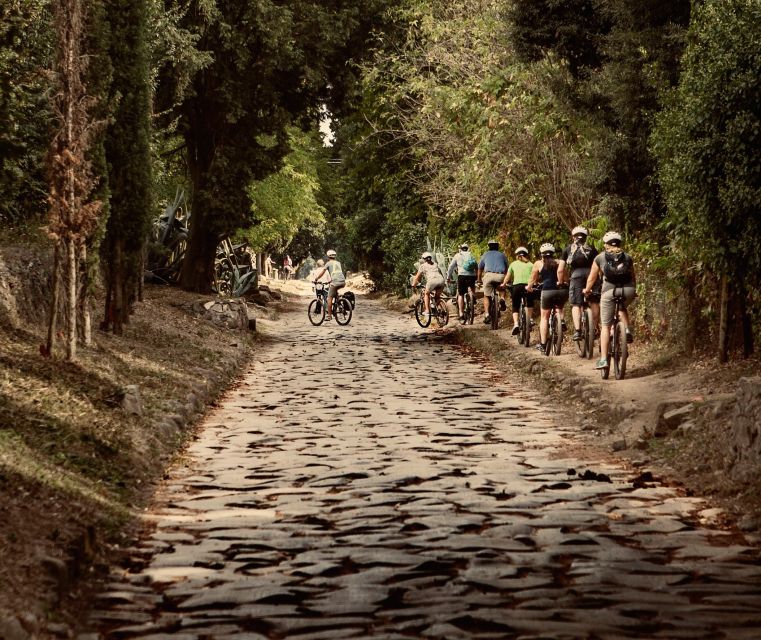
The ride begins near the Aurelian Walls, the huge defensive circuit built around ancient Rome. Passing through this area gives you a useful sense of how the city once defined its edge.
The walls are not simply a quick photo stop. They help explain the shift from the dense ancient center to the open roads outside it. Your guide will set the scene before the group heads onto the Appian Way.
This first part also introduces the main challenge of the route: moving safely through Rome by bicycle. Guides have received strong praise for managing crossings, keeping the group together, and warning riders before busy sections. Anna, Arina, and Bita were each singled out for making nervous riders feel more secure on the road.
Still, you should not treat this as a traffic-free cycling path. If you rarely ride a bike, it is sensible to practice on an e-bike before taking on Rome’s streets.
The Appian Way: Rome’s old road into the countryside
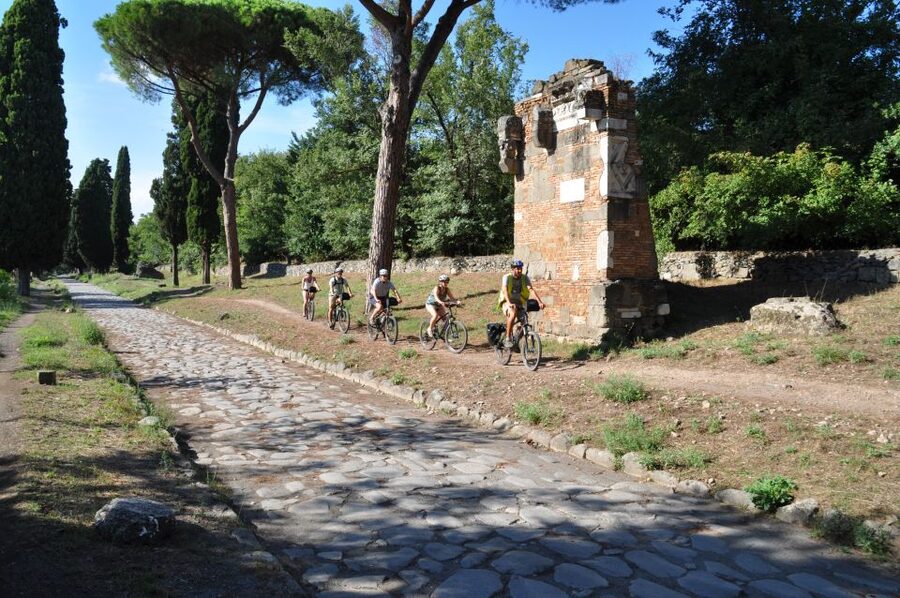
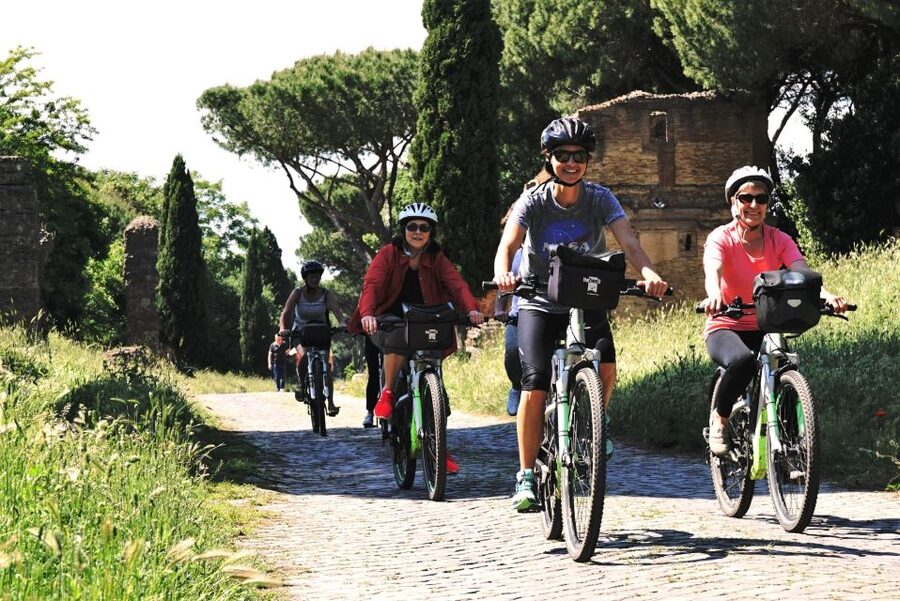
The Appian Way, or Via Appia Antica, is the emotional center of the ride. This road is about 2,300 years old and once linked Rome with the south of Italy. Riding along it gives you something a coach tour cannot provide: you feel the changing surface under your tires and move at the same slow pace that suits the ruins.
The route passes ancient villas, tombs, mausoleums, and fragments of Roman roadside life. You are not viewing the Appian Way from behind a bus window. You are moving through an open-air archaeological area where grass, stone, trees, and ruins share the same space.
The road can be bumpy. One rider who did not often cycle off-road managed well but noted the rough patches. Another found the sturdy bikes dependable but wished for rear suspension. That is fair advice. The e-bikes handle the distance and hills well, but they do not turn the Appian Way into a smooth paved cycle track.
Your guide will stop at several points to explain what you are seeing and allow time for pictures. That pacing is important. A 27-kilometer route could feel like a forced march if the group simply pedaled from point to point. Instead, the stops break up the effort and give the ruins room to make an impression.
More Catacombs and Underground City Tours in Rome
- Rome: Guided Roman Catacombs Tour with Transfers
★ 4.6 · 1,830 reviews - Rome: Catacombs Guided Tour with Transfer
★ 4.2 · 1,808 reviews - Rome EBike Tour: Appian Way, Catacombs & Roman Aqueducts
★ 5.0 · 1,766 reviews - Rome: Catacombs and Capuchin Crypt Guided Tour with Transfer
★ 4.6 · 1,606 reviews
The Catacombs: choose the 6-hour version for the full visit
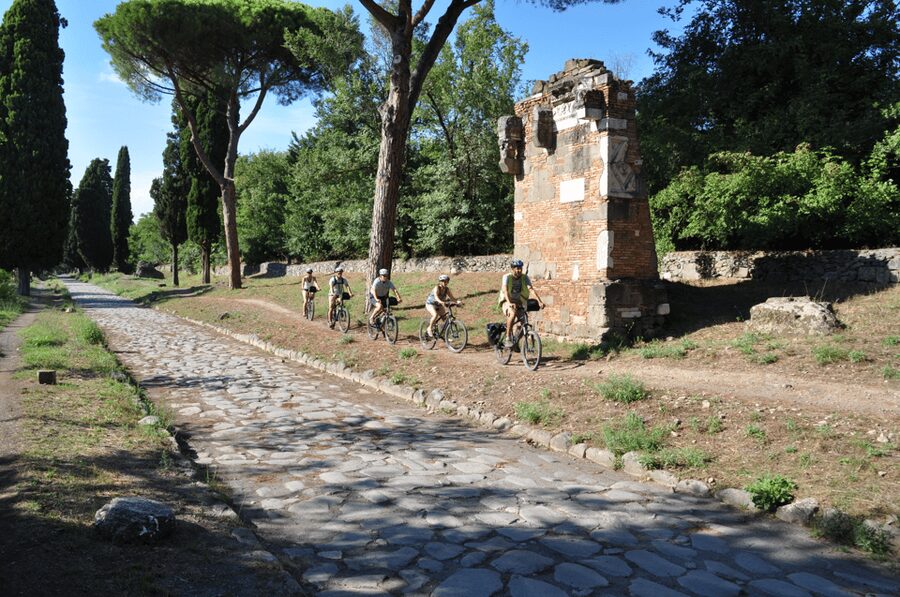
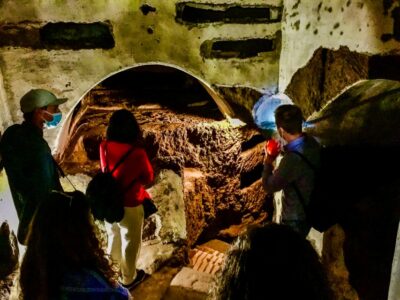
The Catacombs are the biggest difference between the two tour options. On the 6-hour trip, you make a guided underground visit to the Catacombs of St. Callixtus or St. Sebastian. You walk through crypts and corridors connected with early Christian burial practices.
The underground visit adds a different layer to the day. The Appian Way gives you monuments in open air, while the Catacombs turn the focus inward, toward Christian communities and burial customs beneath the road.
On the 4-hour route, you stop at the entrance for a short explanation, usually around five minutes, but you do not go underground. That version still gives you the setting and the basic context, yet it is not a substitute for the guided visit.
I would choose the 6-hour tour if the Catacombs are a priority or if you want the fullest historical program. Choose the 4-hour version if you prefer a lighter outing, have limited time, or would rather keep the day focused on cycling and outdoor sites.
Circus of Maxentius and the Tomb of Cecilia Metella
The route continues past the Circus of Maxentius, one of the major Roman remains along the Appian Way. The site helps show how much activity once lined this road, from grand public buildings to elite burial monuments.
The Tomb of Cecilia Metella is another major landmark. Its round, fortress-like form is one of the most recognizable monuments on the Appian Way. Seeing it by bike works well because the surrounding road and countryside remain part of the view. You are not looking at a single isolated ruin. You are seeing how tombs were placed along an important route into Rome.
These stops also show why a guide adds value. Without explanation, the road can look like a pleasant ride with scattered stones and walls. With context, the villas and tombs become signs of Roman wealth, status, travel, and burial tradition.
Villa dei Quintili and the open Roman countryside
The Villa dei Quintili introduces another side of ancient Rome: enormous private estates outside the city. The villa was associated with wealthy Roman owners, and its scale gives you a sense of how far elite life extended beyond the city walls.
This part of the route feels less crowded than central Rome. You get open views, quiet stretches, and a clear break from the city’s traffic and stone streets. Several riders described this escape as one of the best parts of the day, especially after spending time around the main Roman attractions.
The scenery changes with the season and weather. A sunny day makes the route especially inviting, but one rider still enjoyed the outing in heavy rain. Bring comfortable shoes and dress for the forecast. The tour includes a bottle of water, but food and drinks are not included.
Aqueducts Park: the visual high point
The Roman Aqueducts are the grand finale for many people. At Parco degli Acquedotti, long rows of arches cross the open ground, creating one of the most memorable views outside central Rome.
These structures reveal Roman engineering on a huge scale. The aqueducts carried water over long distances using carefully planned channels and a slight gradient. At the park, the surviving arches make that system easy to understand visually, even if you are not an engineering enthusiast.
The route follows the aqueducts back toward modern Rome. This creates a satisfying connection between the ancient countryside and the present-day city. You are not simply dropped at a ruin and driven away. You cycle beside the structure and watch the setting change as civilization closes in again.
The park is also a good place to appreciate the electric bike. After several hours, you may be glad to have motor assistance, especially on uneven paths or gradual climbs. Riders repeatedly praised the bikes for making the distance feel less tiring. That said, you still pedal, steer, brake, and manage the bike yourself.
Caffarella Park and the return to Rome
After the aqueducts, the ride crosses the green Caffarella Valley. This section gives you another quiet stretch before the return to the city.
Caffarella Park helps keep the tour from becoming a simple ruins checklist. You get trees, open ground, and a slower finish after the larger monuments. It is also a useful contrast with the Appian Way and Aqueducts Park, since the route shows different types of open space around Rome.
The final approach includes the Baths of Caracalla before returning to Via Labicana 49. The Baths are a fitting last stop, since they bring the group back toward the monumental center without sending you straight into the most crowded streets.
The full route can last six hours, and Wednesdays may add about 30 minutes. A longer stop at a pizzeria may be included along the way, but food is not part of the tour price. Carry some money if you want to buy lunch or a snack.
What the ride feels like in practice
The electric assistance is the reason this long route works for a broad range of fitness levels. Riders with little e-bike experience learned the controls quickly, and families used child seats or extensions successfully. Children aged 9 and above may ride their own e-bike, while children aged 5 to 8 use a child extension. Infants aged 1 to 4 can ride in a child seat, free of charge, up to 22 kilograms.
The route is still rated intermediate. The biggest issue is not fitness. It is bike handling. Gravel, bumps, narrow sections, and city traffic require attention. A child seat or extension makes the route more difficult, so families should be realistic about the child’s comfort and the adult’s control.
The tour has a maximum of 10 participants, though the group can be smaller. That size allows the guide to keep an eye on the riders and stop for questions. It also matters on city streets, where a large group would be harder to manage.
Guides speak English, Italian, Dutch, Spanish, French, and German. The guide quality is one of the strongest parts of the outing. Oscar was praised for his humor and care with inexperienced cyclists. Agnese received high marks for detailed explanations and safe route management. Bita, Sina, Ali, and Zac were also praised for combining clear history with a friendly pace.
Is the $85 price good value?
At $85 per person, this is not the cheapest way to see Rome. It is good value if you would otherwise pay separately for transport, a countryside excursion, an Appian Way visit, and a Catacomb tour.
The price includes the Cannondale e-bike, helmet, water bottle, handlebar bag, professional guide, and the Catacomb visit on the 6-hour option. It does not include food or drinks. The larger value comes from the route itself: you cover a lot of ground and reach places that are awkward to connect by public transport.
The 4-hour tour may suit you better if the Catacombs are not essential. The 6-hour option costs more in time and energy, but it gives you the fuller day and underground visit.
Free cancellation is available up to 24 hours before departure, and you can reserve now and pay later. A minimum of four participants applies. If that number is not reached, an alternative or full refund is offered.
Who should book this e-bike tour?
I would recommend it to active visitors who want Roman history with fresh air and open space. It suits couples, families with older children, and anyone who has already seen the central monuments and wants a different side of Rome.
It is especially good for you if you like moving between sights rather than spending the entire day indoors. The combination of road riding, archaeology, parks, and countryside keeps the day varied.
I would be more cautious if you are uneasy on a bike, dislike uneven ground, or want a gentle sightseeing ride. The motor makes pedaling easier, but it does not remove the need for balance, awareness, and confidence around traffic.
Final verdict: book it for Rome beyond the center
This is one of the better ways to reach the Appian Way and Aqueducts Park in a single outing. The route has real variety, the bikes reduce the physical burden, and the guides pay close attention to safety and pacing.
Choose the 6-hour version for the Catacombs and the fullest historical day. Choose the 4-hour version for a shorter ride with the main outdoor sights. I would book this tour if you are comfortable on a bike and want to trade Rome’s crowded center for ancient roads, open parks, and some of the city’s most striking ruins.
FAQ
How long is the Appian Way e-bike tour?
You can choose a 4-hour or 6-hour version. The 6-hour option includes a guided visit to the Catacombs, while the 4-hour option only stops at the entrance for a short explanation.
How far do you ride?
The route is 27 kilometers, or about 17 miles. Around 60 percent of the ride is off-road, and about 40 percent takes place on city streets.
Is the Catacomb visit included?
A guided Catacomb visit is included only with the 6-hour tour. The 4-hour tour includes a short stop at the entrance but does not go underground.
Where does the tour meet?
The meeting point is Via Labicana 49. It is about 10 to 15 minutes on foot from Metro Colosseum and about 10 minutes from Metro Manzoni.
Are electric bikes provided?
Yes. The tour provides Cannondale quality e-mountain bikes with anti-puncture tires, along with a helmet, a 5-liter handlebar bag, and a biodegradable bottle of water.
Is the tour suitable for children?
Children aged 9 and above can ride an e-bike independently. Children aged 5 to 8 use a child extension, and children aged 1 to 4 can use a child seat up to 22 kilograms. Babies under 1 year are not suitable for the tour.
Does the tour include food and drinks?
Food and drinks are not included. You can purchase food and drinks along the way, and the tour includes a bottle of water.
More E-Bike Rides around Rome
- Rome: Appian Way & Catacomb Sunset E-bike Tour with Aperitif
★ 4.5 · 682 reviews - Rome: Appian Way, Catacombs & Aqueducts by eBike + Transfer
★ 4.9 · 421 reviews - E-Bike Mountain Tour in Natural Park +Option Tapas in a Cave
★ 4.7 · 63 reviews
More Cycling Tours around Rome
- Rome: Appian Way & Aqueducts E-Bike Tour (Catacombs & Food)
★ 4.9 · 1,498 reviews - Appian Way Aqueducts Bike Tour (Catacombs & Lunch Option)
★ 5.0 · 975 reviews - Appian Way, Catacombs and Aqueducts Park Tour with Top E-Bike
★ 5.0 · 735 reviews - Rome: Appian Way E-Bike Tour Catacombs, Aqueducts & Picnic
★ 4.6 · 727 reviews
Just added around Rome
- Explore Christian Rome and the Underground of San Clemente★ 4.4 · 16 reviews
- Rome: Colosseum Underground and Arena Floor Tour★ 4.4 · 59 reviews
- Rome: Exclusive Colosseum Underground and Roman Forum Tour★ 4.8 · 569 reviews
- Catacombs of Saint Agnes Entry Ticket & Guided Tour★ 4.5 · 72 reviews
- From Rome: Capri Guided Day Trip with Blue Grotto★ 4.2 · 199 reviews
- Rome: Appian Way, Catacombs & Aqueducts by eBike + Transfer★ 4.9 · 421 reviews
- Private Guided Tour of Colosseum Underground OR Arena and Forum★ 5.0 · 111 reviews
- Private Tour of Catacombs and Ancient Appian Way (hotel pick up)★ 4.5 · 120 reviews
Catacombs & Underground City Tours, compared.
Catacombs of San Gennaro Entry Ticket & Guided Tour
Read our review →
Capuchin Crypts and Catacombs Tour with Transfers
Read our review →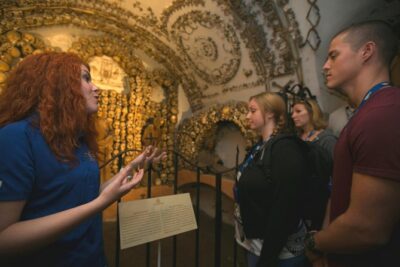
The Original Roman Crypts and Catacombs Tour with Transfers
Read our review →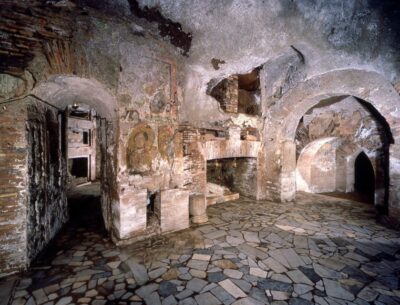
Catacombs of St. Callixtus Entry Ticket & Guided Tour
Read our review →

Full Day Cappadocia Tour( Red Tour + Underground City )
Read our review →