Review · CATACOMBS & UNDERGROUND CITY TOURS
Appian Way Aqueducts Bike Tour (Catacombs & Lunch Option)
Ancient Rome feels different from a bike seat. This half-day ride takes you from the Colosseum area through the Aurelian Walls, along the Appian Way, past Roman tombs and aqueducts, and into Rome’s quieter green spaces. I especially like the chance to leave the city streets behind and the way the electric bikes make a long route possible for ordinary riders. The small-group format, capped at 12 people, also gives the guide room to manage traffic and stop for stories.
The longer version adds the Catacombs of St. Callixtus and a meal or aperitif, depending on the departure time. That makes the $78.60 price good value if you want several major sites in one outing. The catch is simple: this remains a serious bike ride, with traffic, rough cobbles, dirt paths, short hills, and a sore backside possible by the end.
The quick facts that matter
- You ride beyond central Rome: The route reaches the Appian Way, Caffarella Park, the Aqueduct Park, the Circus of Maxentius, and the Baths of Caracalla.
- The five-hour option adds more: It includes the Catacombs of St. Callixtus plus lunch in the morning version or an aperitif in the afternoon version.
- Electric assistance helps, but does not do everything: You still need to pedal, steer, brake, and manage uneven ground.
- The route is historically dense: You see Roman roads, aqueducts, mausoleums, city walls, baths, and an ancient circus in one outing.
- The ride begins and ends near the Colosseum: Meet at Roma STARBIKE on Via dei SS. Quattro, 58, then return there to drop off the bike.
- You need real cycling confidence: The operator requires you to know how to ride a bike well, and the route includes city traffic and rough surfaces.
Starting near the Colosseum and leaving Rome behind
You meet your guide at Roma STARBIKE, a short distance from the Colosseum. After a helmet fitting and a quick setup on your high-quality e-bike, you follow the guide through the city toward the old southern gate.
This opening stretch matters. It is not just a transfer to the countryside. You get a taste of Rome by bicycle, including the need to watch traffic, follow signals, and stay close to the group. For some riders, this is the most stressful part of the tour. Guides such as Alex, Ava, Chris, Iman, Paolo, and Ricardo have been praised for giving clear instructions and checking on riders as the group moves through busy streets.
The electric bikes help on hills and make the distance less tiring, but they do not remove the need for balance and attention. One useful detail: the bikes have suspension, which is welcome once the road turns to stone and dirt.
The experience ends back at the same bike shop. That makes the morning or afternoon easy to plan around, especially if you are staying near the Colosseum or using public transportation to reach the start.
More Catacombs and Underground City Tours in Italy
- Rome: Capuchin Crypts and Catacombs Tour with Transfers
★ 4.6 · 6,456 reviews - The Original Roman Crypts and Catacombs Tour with Transfers
★ 4.5 · 4,896 reviews - Rome: Catacombs of St. Callixtus Entry Ticket & Guided Tour
★ 4.6 · 3,037 reviews
Porta San Sebastiano and the Aurelian Walls
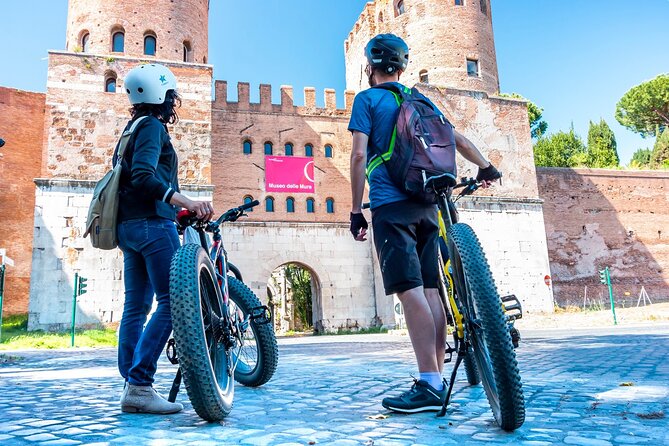
The first main stop is Porta San Sebastiano, one of the large gateways in Rome’s Aurelian Walls. Built around 275 AD, the gate marks the beginning of the historic Via Appia Antica.
Your guide may point out medieval graffiti left by pilgrims over the centuries. It is a small detail, but a memorable one. The gate was not only a defensive structure. It also served as a threshold between the crowded city and the old road leading south.
This stop lasts about 15 minutes, so do not expect a long museum visit. Its value comes from setting up the route. You are about to leave the familiar center of Rome and follow a road built for Roman military movement more than 2,000 years ago.
The Appian Way: Rome’s original road trip
The Via Appia Antica was begun in the fourth century BC under the censor Appius Claudius, known as the Blind. The first section ran from Rome to Capua, then later extensions carried it toward Brindisi, the important port on the Adriatic side of southern Italy.
Romans called it Regina Viarum, the queen of roads. On the bike, you get a physical sense of why the road mattered. This was not a decorative avenue. It was a major route for armies, trade, officials, and long-distance movement across the Roman world.
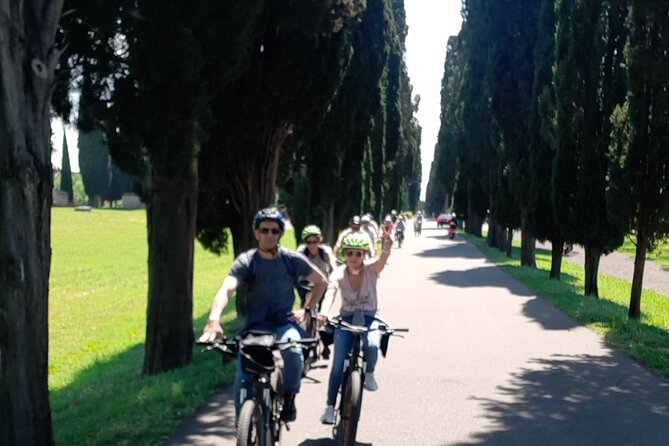
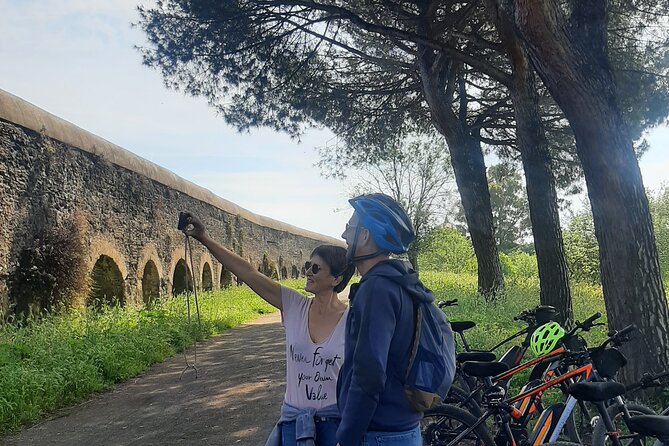
The surface can be rough. Large stones and deep gaps make some sections demanding, and you may need to ride on a dirt edge when the cobbles become awkward. The route is mostly manageable with the electric bike and suspension, but it is not a smooth cycle path.
I would not book this ride if you have not cycled for years. The route includes quick stops, uneven ground, short downhill sections, and moments when you need to brake firmly. You should also expect several hours in the saddle. The scenery is rewarding, but comfort depends on your cycling habits as much as on the motor.
Caffarella Park and the Nymphaeum of Egeria
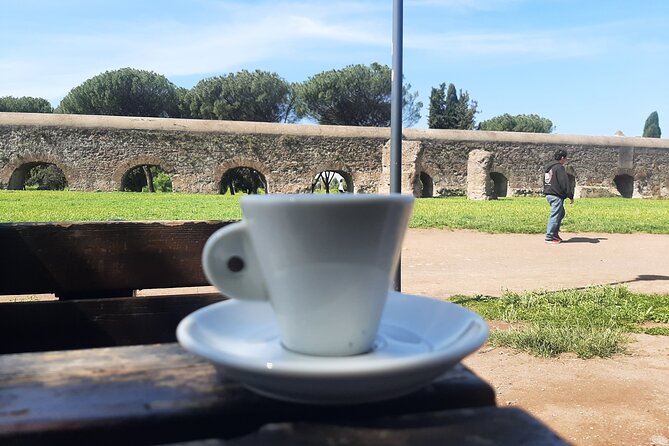
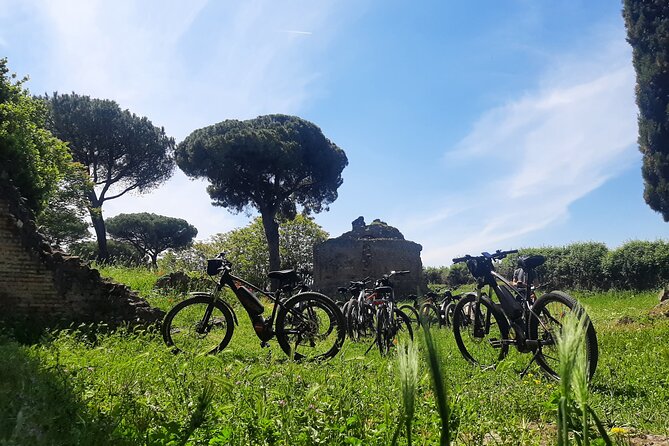
Parco della Caffarella gives the tour its welcome change of pace. This large green area lies inside the Appian Way Regional Park and contains open paths, trees, old farm areas, and remains of ancient buildings.
Here, Rome feels far away even though you are still close to the city. The route provides fresh air and space, with fewer buildings and less traffic. You may see rural details such as goats, chickens, and turtles along the way, as one rider happily discovered.
The guide usually stops to explain what you are seeing rather than racing from one point to the next. That makes a difference. The park is not only a pleasant ride, it helps you understand that ancient Rome extended far beyond the Colosseum and forum.
The Nymphaeum of Egeria is a short stop of about 20 minutes. According to Roman legend, the nymph Egeria loved Numa Pompilius, Rome’s second king. When she learned of his death, her grief created a spring from her tears.
It is a quieter story than the usual tales of emperors and battles. The site adds a touch of myth to the ride, and the spring makes the stop feel connected to the park around it.
More Catacombs and Underground City Tours in Rome
- Rome: Guided Roman Catacombs Tour with Transfers
★ 4.6 · 1,830 reviews - Rome: Catacombs Guided Tour with Transfer
★ 4.2 · 1,808 reviews - Rome EBike Tour: Appian Way, Catacombs & Roman Aqueducts
★ 5.0 · 1,766 reviews - Rome: Catacombs and Capuchin Crypt Guided Tour with Transfer
★ 4.6 · 1,606 reviews
Cecilia Metella and the medieval Caetani fortress
The Mausoleum of Cecilia Metella is one of the most impressive tombs along the Appian Way. Built in the first century BC, it is a large pagan monument that later became part of the medieval Castrum Caetani.
You can also see the remains of the Caetani family’s medieval complex and the walls of San Nicola church. The stop shows how one important Roman site changed purpose over many centuries. Ancient tomb, medieval fortress, and church ruins occupy the same small area.
The visit here is about 20 minutes. That is enough for an explanation and photographs, but the tour is not designed as a full archaeological visit with extended indoor time. The focus is the broad story of the road and its monuments.
The five-hour option and the Catacombs of St. Callixtus
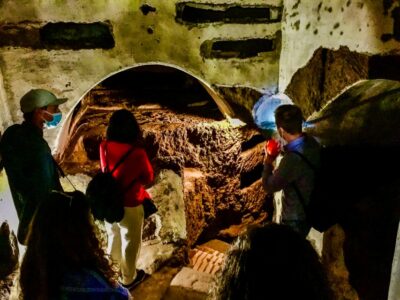
The longer tour adds a guided visit to the Catacombs of St. Callixtus. This is the largest underground cemetery in Rome, with corridors extending about 20 kilometers. The complex dates to the second century BC and became a major burial site for Christians.
More than 50 martyrs, 16 popes, and hundreds of thousands of Christians were buried there. The guided visit lasts about 50 minutes and changes the mood of the day. After the open air, trees, and ancient roads, you move into narrow underground passages linked to early Christian history.
The catacombs are a strong reason to choose the five-hour tour, especially if you want religious history alongside Roman engineering and military roads. You should be comfortable with an underground setting and with a tour that is active from start to finish.
The extra hour is not a minor add-on. It brings another major subject into the day and gives the route a stronger sense of variety. If you want a shorter ride or know that several hours on a bike will be enough, the four-hour option may suit you better.
Aqueduct Park and the engineering of ancient Rome
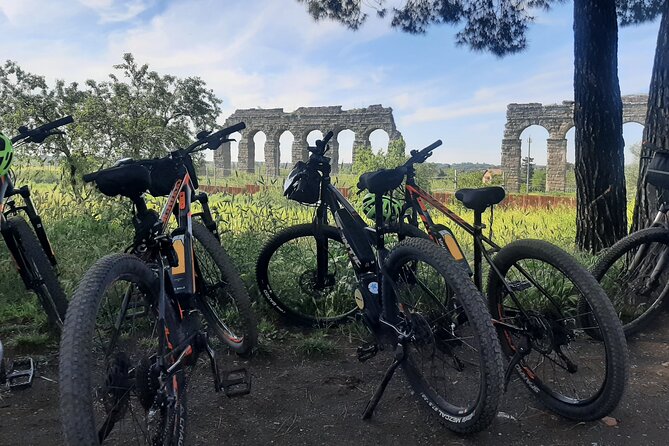
Parco degli Acquedotti is the visual high point for many people. Here, huge arches cross open green space, giving you a clear view of how Roman engineers carried water over long distances.
The park was linked to the ancient Via Latina and formed part of Rome’s water network. Several aqueducts remain visible, and some sections are surprisingly well preserved. The scale is hard to grasp from a city street. Out in the open, you can follow the line of the arches and see how much land the system crossed.
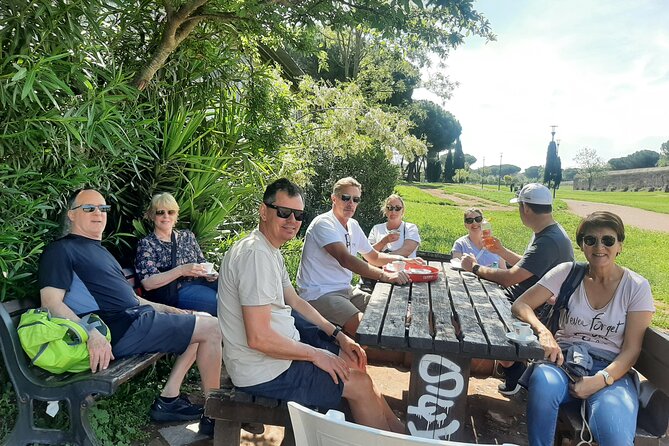
The five-hour version includes food at this point. The morning departure includes lunch, described as Italian specialties at a restaurant, while the afternoon departure replaces the meal with an aperitif. The tour information also refers to a boxed lunch, so food presentation may vary by departure or operating arrangement. Either way, the longer option includes a planned break here, while the four-hour version does not include lunch or an aperitif.
This stop is useful for more than photographs. The aqueducts explain why Rome could support large baths, fountains, private homes, and public buildings. Your guide can connect the arches in the park with the water system that fed the Baths of Caracalla later in the route.
The Circus of Maxentius and the final Roman monuments
The Circus of Maxentius is one of the best-preserved Roman circuses. Its central spine, or spina, remains visible. The obelisk once associated with it was moved during the Renaissance and now forms part of the Fountain of the Four Rivers in Piazza Navona.
The stop lasts about 20 minutes. It is a good reminder that Roman entertainment was not limited to the Colosseum. Chariot racing drew huge crowds, and a circus required a long, carefully planned building with seating, a track, and a central divider.
The ride then returns toward the city and the Baths of Caracalla. Built by Emperor Caracalla, these were the largest public baths in the Roman world for about a century. Much of the structure still survives, so you can picture the enormous scale of the complex even from a short stop.
A branch of the Aqua Marcia supplied water to the baths through the Antoninian aqueduct. That link brings the day full circle. You have seen the water channels in the open countryside, then arrive at the grand public building that depended on them.
How hard is the ride?
The operator lists a moderate fitness requirement and says you must know how to ride a bike well. That warning deserves attention.
You will deal with:
- City streets near the start and finish
- Paved roads and cycle paths
- Large Appian Way cobbles
- Dirt tracks and wooded paths
- Short hills and downhill sections
- Several hours of pedaling, even with electric help
The e-bike gives your legs a rest, especially in warm weather and on inclines. Still, you control the brakes and steering. One rider found the strong brakes surprising and fell, although the guide helped and the rider completed the route.
Wear practical clothes and closed shoes. Bring water, and do not assume the motor makes this a passive sightseeing trip. If your cycling experience is limited, the four-hour tour is the safer choice. If you ride regularly and want the fullest route, the five-hour version offers better value.
Children aged 6 to 10 can receive a reduced rate only if they are under 143 centimeters tall. They use a trailer bike rather than riding alone. A child seat is included for children up to 25 kilograms. The maximum rider weight is 120 kilograms.
Guides, group size, and the value of the price
At $78.60 per person, the tour is not the cheapest way to see Rome. It includes the e-bike, helmet, phone holder, handlebar holder, child equipment, guide, and the longer version’s catacomb visit and food service.
That package compares well with arranging separate transport to the Appian Way, hiring a bike, finding the right roads, and booking a catacomb visit. You also get the benefit of a guide who knows how to move a group through Roman traffic.
Guide quality appears to be one of the tour’s strongest features. Alex is praised for safety checks, historical stories, and an entertaining style. Ava is described as friendly and attentive. Chris receives credit for allowing time for photos and explaining the sites without rushing. Iman is also a historian and a strong cyclist who gives clear route instructions.
The group limit of 12 is important. A larger group would be harder to control on traffic-filled streets and narrow paths. Small size also gives you a better chance to ask questions and stay connected with the guide.
The experience receives a 4.8 rating from 975 reviews, with 97 percent recommending it. Those numbers fit the main pattern: high satisfaction when riders understand that this is an active outing, not a gentle sightseeing shuttle.
Should you book the four-hour or five-hour ride?
Choose four hours if you want the Appian Way, parks, tombs, aqueducts, Circus of Maxentius, and Baths of Caracalla without adding the underground visit and meal. It is also the better choice if you are unsure about your stamina.
Choose five hours if you want the complete historical mix. The Catacombs of St. Callixtus add a powerful religious and archaeological stop, and the included lunch or aperitif gives you a planned pause. The longer route offers the strongest value for anyone who is comfortable cycling.
I would book this tour if you want to see a quieter side of Rome and enjoy learning while moving. I would skip it if you dislike bikes, have trouble on uneven surfaces, or want a relaxed day with little physical effort.
The tour is weather dependent. You can cancel for a full refund up to 24 hours before the start time, and poor weather may lead to a new date or full refund. That flexibility is useful because the open-air route is at its best in dry conditions.
FAQ
Where does the Appian Way bike tour start?
It starts at Roma STARBIKE, Rome eBike Tours & Experiences, at Via dei SS. Quattro, 58, 00184 Rome.
Where does the tour finish?
The tour finishes back at the same bike shop where you collect the e-bike and helmet.
How long does the tour last?
The tour lasts approximately four to five hours, depending on the option you book.
Is the Catacombs of St. Callixtus visit included?
The guided catacomb visit is included only in the five-hour tour.
Is lunch included?
Lunch is included in the morning version of the five-hour tour. The afternoon version includes an aperitif instead. Food is not included in the four-hour tour.
Are bikes and helmets provided?
Yes. A high-quality electric bike and helmet are included. A mobile phone holder and handlebar holder are also provided.
Can children join the tour?
Children can join. A child seat is available up to 25 kilograms, and children aged 6 to 10 can use a trailer bike if they are under 143 centimeters tall.
Do I need to be fit to join?
You need moderate physical fitness and must know how to ride a bike well. The route includes traffic, cobblestones, dirt paths, hills, and several hours of cycling.
What happens if the weather is poor?
If the tour is canceled because of poor weather, you will be offered another date or a full refund. You can also cancel at least 24 hours before the start time for a full refund.
More Trips with Lunch around Rome
- Rome: Appian Way Aqueducts Bike Tour (UPG Catacombs & Lunch)
★ 4.9 · 692 reviews - Chichen Itza, Cenote & Valladolid Tour with Tequila and Lunch
★ 4.5 · 15,789 reviews - Cancun: Chichen Itza, Cenote & Valladolid Tour with Lunch
★ 4.6 · 6,722 reviews - Athens: Meteora Monasteries Day Trip with Caves and Lunch
★ 4.7 · 4,670 reviews
More Cycling Tours around Rome
- Rome: Appian Way & Aqueducts E-Bike Tour (Catacombs & Food)
★ 4.9 · 1,498 reviews - Rome: Appian Way, Catacombs, & Roman Aqueducts E-bike Tour
★ 4.9 · 1,421 reviews - Appian Way, Catacombs and Aqueducts Park Tour with Top E-Bike
★ 5.0 · 735 reviews - Rome: Appian Way E-Bike Tour Catacombs, Aqueducts & Picnic
★ 4.6 · 727 reviews
Just added around Rome
- Explore Christian Rome and the Underground of San Clemente★ 4.4 · 16 reviews
- Rome: Colosseum Underground and Arena Floor Tour★ 4.4 · 59 reviews
- Rome: Exclusive Colosseum Underground and Roman Forum Tour★ 4.8 · 569 reviews
- Catacombs of Saint Agnes Entry Ticket & Guided Tour★ 4.5 · 72 reviews
- From Rome: Capri Guided Day Trip with Blue Grotto★ 4.2 · 199 reviews
- Rome: Appian Way, Catacombs & Aqueducts by eBike + Transfer★ 4.9 · 421 reviews
- Private Tour of Catacombs and Ancient Appian Way (hotel pick up)★ 4.5 · 120 reviews
- Hidden Gems & Rome Catacomb Semi Private Tour by golf cart★ 5.0 · 114 reviews
Catacombs & Underground City Tours, compared.
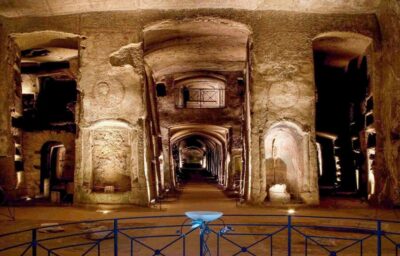
Catacombs of San Gennaro Entry Ticket & Guided Tour
Read our review →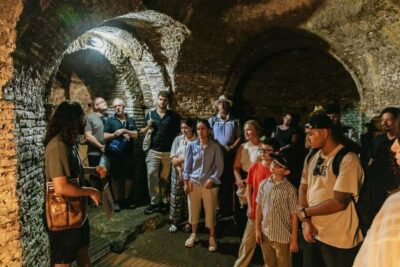
Capuchin Crypts and Catacombs Tour with Transfers
Read our review →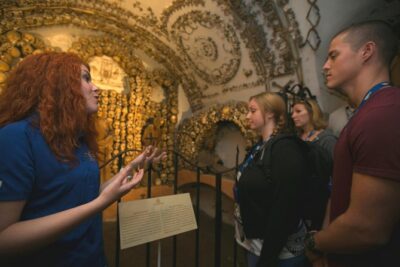
The Original Roman Crypts and Catacombs Tour with Transfers
Read our review →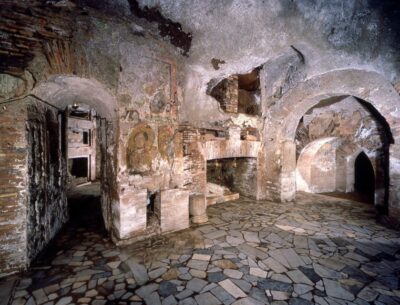
Catacombs of St. Callixtus Entry Ticket & Guided Tour
Read our review →

Full Day Cappadocia Tour( Red Tour + Underground City )
Read our review →